
We Are Already Closer to the End of Legal Abortion Than We Think
If a conservative judge like Brett Kavanaugh is appointed to the Supreme Court, we can expect a barrage of dangerous new anti-abortion restrictions proposed and enacted across the country.
Originally published August 10, 2018 by Broadly
During a 2016 campaign stop, Mike Pence promised voters that Roe v. Wade would be “consigned to the ash heap of history” should Donald Trump be elected President. This February, Pence doubled-down on this vision when he announced his goal to end legal abortion “in our time” at a luncheon hosted by an anti-abortion group held in Nashville.
On the campaign trail, Trump also promised to nominate justices who would overturn Roe v. Wade. in support of that aim, following the announcement of Supreme Court Justice Anthony Kennedy’s resignation, he relied on the recommendations of religious conservative Leonard Leo of the Federalist Society, a man who has been lauded for his dedication to “building a Supreme Court that will overturn Roe v. Wade.” The resulting nominee is Brett Kavanaugh, a man who recently supported the Trump administration’s policy of denying abortion access to immigrant women in federal custody, and a reliable conservative vote.
If a conservative judge like Brett Kavanaugh is appointed to the Supreme Court, we can expect a barrage of dangerous new anti-abortion restrictions proposed and enacted across the country.
Originally published August 10, 2018 by Broadly
During a 2016 campaign stop, Mike Pence promised voters that Roe v. Wade would be “consigned to the ash heap of history” should Donald Trump be elected President. This February, Pence doubled-down on this vision when he announced his goal to end legal abortion “in our time” at a luncheon hosted by an anti-abortion group held in Nashville.
On the campaign trail, Trump also promised to nominate justices who would overturn Roe v. Wade. in support of that aim, following the announcement of Supreme Court Justice Anthony Kennedy’s resignation, he relied on the recommendations of religious conservative Leonard Leo of the Federalist Society, a man who has been lauded for his dedication to “building a Supreme Court that will overturn Roe v. Wade.” The resulting nominee is Brett Kavanaugh, a man who recently supported the Trump administration’s policy of denying abortion access to immigrant women in federal custody, and a reliable conservative vote.
Despite the morbid enthusiasm expressed by Pence and members of the Federalist Society, many legal theorists doubt the fragility of Roe, even with a conservative majority on the court. As the Center for Reproductive Rights president Nancy Northup writes in the Washington Post, this is because Roe is fundamentally tied to constitutional protections that guarantee personal liberty free from government interference — protections that are “bound together through decades of accumulated legal precedent.” And while precedents certainly don’t last forever, the path of least resistance for anti-choice proponents is to incrementally chip away at abortion access until there’s an opportunity to untie abortion from personal-liberty, a tactic that’s already regularly employed. Some have appropriately called this stratagem, “death by a thousand cuts.”
If presented with an appropriate case, a fifth conservative Justice like Kavanaugh could certainly decide that abortion is no longer a protected right, overturning Roe. If this happens, 23 states could criminalize abortion immediately, and only nine states have included the right to abortion in their respective state constitutions to protect abortion access in the absence of Roe. Women who are unfortunate enough to live in states that outlaw the procedure will be forced to travel hundreds of miles, as many do now, to places as far as Mexico, California, or New Jersey, for abortion services. For many people without access to transportation, the privilege of taking time off from work, or access to childcare, abortion access will be near to impossible.
However, we are more likely to see a barrage of new abortion regulations that will make abortion access much more difficult, if not impossible. A conservative court is likely to see regulations, such as extended waiting periods, hospital admitting privileges, and other TRAP laws, as a mere inconvenience rather than a constitutionally-conflicted “undue burden”, and thus, legally permissible, even if the regulations, or those “thousand cuts,” effectually create an insurmountable burden for most.
While we can theorize endlessly about the innumerable ways in which our reproductive futures are doomed, let’s consider the realities that await us, regardless of the ways in which they will be justified. If you’re a low-income woman, young person, or a single mother, things are going to be much more difficult for you — particularly if you live in areas of the country where abortion access is already scarce. Currently, Kentucky, Mississippi, Missouri, North Dakota, South Dakota, West Virginia, and Wyoming have only one abortion clinic in addition to harsh restrictions such as mandated waiting periods. As of 2014, 90 percent of US counties lack an abortion provider, creating so-called “abortion deserts” where residents are forced to travel 100 miles or more to the nearest clinic.
With a conservative majority on the court, we can expect bold new anti-choice restrictions proposed and enacted across the country. Placing their faith in partisan judges who rely on support from conservative legislators, lawmakers will likely push for severe regulations that will shutter many remaining clinics. Across the country, 31 states have implemented unnecessary abortion regulations such as waiting periods, requirements that clinics meet ambulatory surgical center standards, or obtain hospital admitting privileges. Today, even with Roe in place, millions of people are already facing massive obstacles when seeking safe, legal abortion services. An increase of new anti-choice policies will force more clinics to shutter, and leave many more women without access to abortion services.
Already, since the 2016 election, fundamental reproductive liberties have been repeatedly attacked. Emboldened by the current administration, many state legislators have proposed an onslaught of dreadful anti-abortion restrictionsthat seek to dismantle the core tenets of Roe. In 2017 alone, 19 states adopted 63 new abortion restrictions including a ban on abortion after the detection of a fetal heartbeat in Iowa or after the 15th week of pregnancy in Mississippi, the earliest ban in the nation. In Ohio, Republican representatives Ron Hood and Nino Vitale introduced a bill that would ban abortions totally, without exception. Under the bill, the fetus or “unborn human,” as defined in the law, would be considered a person under the state criminal homicide statutes, which means that abortion providers or people who have had an abortion could be charged with murder — a crime that’s punishable by death in the state. While the bill is brazenly unconstitutional, Hood and Vitale have revealed a calculated strategy to push extreme anti-choice laws up the judicial ladder in hopes of creating a constitutional challenge that would end the right to abortion.
Similarly, Justice Kennedy’s departure has shined new light on recently litigated cases that have been ruled unconstitutional by lower courts, such as Indiana’s HEA 1337 which was signed into law by Pence when he served as the state's governor. The legislation—which sought to restrict abortions on the basis of gene abnormalities that may cause severe disabilities—was overturned in federal appeals court as a violation of “well-established Supreme Court precedent.” Now, Indiana needs only to appeal up to the Supreme Court, and should the Court accept the case, an opportunity to redefine the future of abortion rights in America could be realized within the next year.
Consider the situation you are in at this very moment: are you able to purchase a last minute flight, rental car, and hotel room for several days if you needed to? How flexible is your employment arrangement? Do you have a network of support that could assist you in an emergency? These are the questions women already have to ask themselves in many states, and we all need to begin planning for this possibility.
If this bleak future wasn’t already dark enough, consider the experiences of expecting parents who are diagnosed with fatal pregnancy complications, such as Sheva Guy of Ohio, whose daughter was diagnosed with a fatal spinal abnormality at 22 weeks. Due to abortion regulations and long wait-times at the only clinic that could perform a second-trimester termination procedure, she was forced to travel 300 miles and spend over $3,000 to obtain an abortion. Her story is not unusual. In Texas, Taylor Mahaffey was forced to endure a stillbirth at 20 weeks due to state abortion restrictions. These laws aren’t humane, or necessary, and they do not make room for the nuance of women’s experiences. Abortion is shamefully classified as a hedonic extravagance, instead of a necessary medical procedure to preserve the life and wellbeing of women and families. There will be more stories like Sheva’s and Taylor’s. There will be more traumatic stillbirths, and there will be more pain and suffering.
This is not a dystopian fantasy or ominous prediction.
Before Roe v. Wade, thousands of American women were dying a year due to illegal abortions. Desperate, women were throwing themselves down staircases, ingesting pesticides, and thrusting sharp objects into their cervix, causing death, infertility, and illness. Worldwide, it’s estimated that 25 million unsafe abortions occur each year. This number will increase if abortion restrictions tighten in America, regardless if Roe is overturned. In countries where abortion has been criminalized, women who have miscarried have been sentenced to decades in prison and doctors have been fined for providing information about abortions online. What’s standing in the way of a similar future for us?
Already, in places like Texas where the average county is 111 miles from the nearest clinic, researchers at The University of Texas estimate that between 100,000 and 240,000 Texas women have attempted to self-induce an abortion at some point in their lives. Nationwide, Google search results demonstrate a growing interest in terms such as “how to self-abort,” with the highest occurrence in places such as Mississippi—where there’s only one abortion clinic left. We already know that the rate of teen suicide increases where abortion is unavailable, and we know that criminalizing abortion does not prevent women from terminating their pregnancies. In fact, a recent UN report classified an absence of abortion access as “torture.” Nevertheless, Pence has vowed that he, “will not rest until we restore a culture of life in America.” A cruel irony sharpened by truth that the so-called “culture of life” is paid for with the lives of vulnerable women.
Unfortunately, we don’t have to imagine a world without Roe to feel the blow dealt by Justice Kennedy’s resignation. With the push to end abortion in many conservative states, we already have an idea of what the future will look like with increased regulations. Anti-abortion extremists sitting in Congress and the Trump administration have made no secret of their intentions. It’s clear that they will stop at nothing to chip away at our reproductive liberties until they’re gone. Let me be clear: This is not a dystopian fantasy or ominous prediction. We are, at this moment, witnessing the development of a strategic state-sponsored forced birth program. No matter what comes next for Roe, we must now turn our attention to what’s happening at the state level and stop the imposition of incremental violations intended to chip away at our reproductive liberties.
How the Catholic Church—and the GOP—Came to See Birth Control as Evil
In the 60s, the Catholic Church came close to reversing its position on contraception as sinful. It didn't, obviously, and women today are still suffering under policy influenced by religious dogma.
Originally published in Broadly, May 24, 2018
This past February, Idaho State Senator Dan Foreman was videotaped berating a group of university students scheduled to meet him to discuss comprehensive sex education and a bill to increase access to birth control. “Abortion is murder. I stand against it,” Foreman shouted as he waved his bony finger at the students, who had driven 300 miles to meet him. “I’m a Roman Catholic; I’m a conservative Republican. I think what you guys do stinks.”
Despite Foreman’s outrage, the students weren’t there to discuss abortion rights at all, but rather to have a conversation about policies that would make contraception more accessible to women in the state and improve sex ed. Both of these things would in fact, reduce the abortion rate in Idaho—a topic that should theoretically have been a top priority for Foreman, considering his belief that abortion is morally equivalent to murder.
In the 60s, the Catholic Church came close to reversing its position on contraception as sinful. It didn't, obviously, and women today are still suffering under policy influenced by religious dogma.
Originally published May 24, 2018 by Broadly
This past February, Idaho State Senator Dan Foreman was videotaped berating a group of university students scheduled to meet him to discuss comprehensive sex education and a bill to increase access to birth control. “Abortion is murder. I stand against it,” Foreman shouted as he waved his bony finger at the students, who had driven 300 miles to meet him. “I’m a Roman Catholic; I’m a conservative Republican. I think what you guys do stinks.”
Despite Foreman’s outrage, the students weren’t there to discuss abortion rights at all, but rather to have a conversation about policies that would make contraception more accessible to women in the state and improve sex ed. Both of these things would in fact, reduce the abortion rate in Idaho—a topic that should theoretically have been a top priority for Foreman, considering his belief that abortion is morally equivalent to murder.
Scientifically and medically speaking, contraception access and comprehensive sexual education are key to reducing the abortion rate. That’s because more than 90 percent of abortions are the result of unintended pregnancy; and if we want to reduce the abortion rate, we clearly must reduce the number of unintended pregnancies. Copious research shows the best way to do this is through promoting the use of contraception. In fact, the US rate of abortion is currently at its lowest point since it was legalized in 1973 — a decline researchers have attributed to increased use of reliable long-term birth control methods such as IUDs. And, unsurprisingly, when women are provided free birth control, the abortion rate plummets even more.
If contraception is so effective at lowering the abortion rate, it would seem to make sense for rabidly anti-abortion politicians like Sen. Foreman to be pushing to have free birth control and condoms available across the state. But Foreman is Catholic, and he believes that birth control is evil, and prioritizes ecclesiastical interpretations of reproductive ethics over secular law and proven medical data.
In 1970, 66 percent of Catholic women said they had used contraception... Today, a full 98 percent of Catholic women say they’ve used a form of birth control.
How did we get to a place where religious opinion dictates the health and wellbeing of Americans? While neither the Old nor the New Testament contains language specifically addressing contraception or abortion, all Catholic, Protestant, and Orthodox denominations have been in agreement that contraception is a mortal sin since at least the second century. Since 1930, however, the Anglican church has permitted the use of contraception "when there is a clearly felt moral obligation to limit or avoid parenthood and where there is a morally sound reason for avoiding complete abstinence.” As a result, most Protestants today accept the use of modern contraceptives.
Catholics have not been quite so tolerant. In 1963—six years after the pill was first introduced on the market—Pope Paul VI commissioned a study to analyze the morality of birth control. The commission, which was comprised of laypeople, theologians, and bishops, worked for two years on the report, during which time the Second Vatican Council affirmed Church’s position that “life must be protected with the utmost care from the moment of conception.”
In 1966, the commission overwhelmingly encouraged the Church to rescind its ban on contraception and reverse its position that birth control is “intrinsically evil.” This, presumably, was not what Pope Paul VI wanted to hear; in 1968, he ignored the advice of his own pontifical commission and released a widely controversial text entitled Humanae Vitae (Latin: Of Human Life), subtitled On the Regulation of Birth.
In the text, he argued that anything “specifically intended to prevent procreation” is to be “absolutely excluded as a lawful means of regulating the number of children." Per his interpretation, family planning is considered an abomination and a direct violation of the will of God, who ultimately decides when and if a marriage should produce children. Additionally, the encyclical detailed several grave consequences that result from the use of birth control, including “marital infidelity and a general lowering of moral standards.”
Humanae Vitae was greeted with “public outcry,” according to an articlepublished in the Undergraduate Review. “There was mass disbelief,” it reads. “Almost everyone was shocked and amazed that the Pope would disregard the [commission] entirely.” The result, overwhelmingly, was disillusionment with the Church. Of course, many Catholics chose to ignore the edict altogether: In 1970, 66 percent of Catholic women said they had used contraception, a rate that grew to 94 percent by 1980. Today, a full 98 percent of Catholic women say they’ve used a form of birth control.
Despite the edicts of the church, birth control initially enjoyed bipartisan support following its legalization in 1960. In fact, Republicans strongly supported family planning and contraception access as good economic policy. In 1970, Republican President Richard Nixon enthusiastically signed Title X into law, providing federal funding for family planning services. But a year later, in a bid for Southern voters disaffected by civil rights advances in the south, Nixon’s advisors encouraged him to reverse his position on family planning to bring conservative Catholics into the Republican camp.
This moment marked a monumental shift in Republican strategy, notably because embracing the evangelical and Catholic community was a wildly successful strategy for winning elections. Likewise, politicizing religious issues was a powerful tool for filling church pews.
In 1976, four years after Nixon won his reelection bid in a landslide victory, the Republican National Convention addressed abortion for the first time in the party’s history, adopting “a position on abortion that values human life” as part of the Republican Party platform. The GOP had hoped that endorsing an anti-abortion position would win the support conservative religious voters and paint the Democratic party as anti-Catholic.
After this, the politicization of contraception became a proxy for the predominance of religious influence in the US. Over the next five decades, funding for and access to contraception—both at home and overseas—became a political bargaining chip. Views on abortion and contraception quickly became a litmus test for the GOP, catalyzed by religious conservatives, who basically spoon-fedanti-choice rhetoric directly into the mouths of candidates.
This symbiotic relationship—between Catholic and evangelical leaders and establishment Republicans—has survived decades of sexual revolution and changing attitudes about sexuality. Under the Trump administration, it’s grown more powerful than ever.
During the 2016 presidential election, Trump tailored his campaign to address the interests of conservative religious voters, specifically courting anti-abortionleaders and choosing a hardline anti-contraception, pro-religion running mate Mike Pence, resulting in a record 81 percent white, evangelical vote for Trump.
Less than a year after taking office, in a demonstration of loyalty to these conservative religious voters, President Trump released new rules that drastically rolled back the contraceptive coverage mandate. The rules also vastly expanded exemptions to allow any employer or insurer the right to deny birth control benefits on the grounds of “religious or moral objection,” placing 55 million women who receive free contraceptives at risk. The mandate explicitly suggested that that contraceptive access promotes “risky sexual behavior” among some teenagers and young adults—a claim that comes straight from the mouth of the church and has zero medical credibility.
On May 3 of this year, during the National Day of Prayer, President Trump stood in the Rose Garden alongside evangelical advisors and religious leaders and declared, “Faith is more powerful than government, and nothing is more powerful than God.” If that’s the case, we’re all screwed. The moral and “religious liberty” arguments espoused by the current administration don’t just impact Catholics, but all of us — especially considering that one in six US hospital beds are in Catholic facilities, which have the right to legally deny services to patients, including children, in accordance with their religious or “moral” beliefs. When we value the personal, religious beliefs of the powerful over the constitutional rights of marginalized groups in need of healthcare, the dignity and freedoms of our society as a whole are degraded.
Make no mistake: Attacking access to contraception is not about protecting religious freedom. It’s not even about protecting “life.” It’s about furthering the agenda of corrupt religious institutions who seek social and cultural dominance through systematic control of our sexuality, and their partnership with political actors who seek to maintain positions of power and influence. Contraception is vital to liberate ourselves from this oppression, which is why it’s perceived as a threat—and why it must be protected at all costs.
Stormy Daniels' Detroit stop shows she's beating Trump at his own game
Originally published on the Metrotimes April 19, 2018
The DJ’s voice echoed throughout the club dripping in neon, mirrors, and nude women — “Are you ready to meet the most famous woman in the world?” The slew of Detroit police who had just raided the club to verify cabaret licenses had finally left and the crowd was anxious to see the woman who's rocked the world by taking a stand against the President of the United States. A congregation of fans from the packed room swarmed the glowing red, white, and blue catwalk and erupted in cheers as Stormy Daniels appeared draped in a short red cape and g-string and began to grind up on the stripper pole to Lenny Kravitz’s “American Woman.”
Daniels possesses the kind of marketing genius that Trump fans admire, leveraging the current controversy to book jobs and appearances including her “Make America Horny Again” tour at strip clubs across the country, which is how she found herself at Truths Gentleman’s Club on 8 Mile and Mound Road.
Originally published April 19, 2018 by the Metrotimes
The DJ’s voice echoed throughout the club dripping in neon, mirrors, and nude women — “Are you ready to meet the most famous woman in the world?” The slew of Detroit police who had just raided the club to verify cabaret licenses had finally left and the crowd was anxious to see the woman who's rocked the world by taking a stand against the President of the United States. A congregation of fans from the packed room swarmed the glowing red, white, and blue catwalk and erupted in cheers as Stormy Daniels appeared draped in a short red cape and g-string and began to grind up on the stripper pole to Lenny Kravitz’s “American Woman.”
Daniels possesses the kind of marketing genius that Trump fans admire, leveraging the current controversy to book jobs and appearances including her “Make America Horny Again” tour at strip clubs across the country, which is how she found herself at Truths Gentleman’s Club on 8 Mile and Mound Road.
After canceling two previously scheduled appearances due to an illness and travel issues, Daniels was finally in Detroit. Every booth in the club was full of admirers, from apparent Trump fans wearing MAGA hats who said they were there to “enjoy what Trump enjoys,” to the local Liberty Riders motorcycle club, and the die-hard who drove three hours one-way to get his personal Stormy DVD collection signed by the star. She graciously received each person who paid $20 to meet her (a fee the club keeps, according to Daniels’ security), and offered bracelets to supporters that read “Standing up to bullies is kind of my thing. #TeamStormy.” It’s a message that provides some insight into the political drama Daniels has walked into outside of her life as an adult entertainer.
Daniels, who was born Stephanie Clifford, is an award-winning adult film star, actress, stripper, screenwriter, and director who says that she engaged in a consensual sexual relationship with Donald Trump more than a decade ago and is suing to nullify a non-disclosure agreement she signed on October 28, 2016, eleven days before the presidential election. In addition to the agreement, Trump Organization lawyer Michael Cohen personally paid Daniels $130,000 for her silence and has claimed that neither Trump nor his campaign knew about the payoff. Trump has consistently denied the affair, despite photographs showing the two together at the golfing event where they allegedly hooked up.
In a recent “60 Minutes” interview, Daniels said that she accepted the money and agreement because she was concerned about her career and her family stemming from a confrontation she had with an unknown man who threatened her the first time she tried sell the story of the affair to In Touch Weekly in 2011, which was scrapped after Cohen threatened to sue the outlet. Despite the threats, Daniels decided to go to the press and tell the truth about the encounter, to, in her words, “set the record straight.”
While Daniels persistently claims that her public allegations are about “telling the truth,” rather than the money, there’s certainly room to believe that the motivation for Daniels coming forward is a combination of both. After all, she might need all that cash considering that Trump’s lawyer is going after her for an outrageous $20 million in damages for violating the hush-agreement.
But as she raises her profile with a national tour, the adult film star claims to want nothing to do with politics. Last night, as Daniels greeted fans, she steered clear of an eerily convincing Trump impersonator brought in by the club. Earlier in the day, she told told Fox 2 Detroit that she was looking forward to her show but wanted “no politics” involved.
While her evasion of the “political” at her performances seem unrealistic considering her new brand of patriotic eroticism is tied to her ongoing legal battle with the President of the United States, Daniels doesn’t want to be defined exclusively as Trump’s mistress. Nor should we reduce her to as much. When she hits the stage topless and in a g-string, and dozens of men make it rain around her, it’s not because Trump slept with her, it’s because she’s beating Trump at his own game and doing it on her own terms.
Unlike Trump, Daniels is a self-made success who hustled to the top by gaming a system that typically exploits women to the benefit of men. Trump, a billionaire with every advantage and opportunity handed to him, allegedly used his influence and wealth to persuade a woman half his age to sleep with him by making false promises about a potential opportunity on TV. When he learned that she was going to discuss their affair publically, something she has every right to do, he ordered someone to physically threaten her and employed his team of attorneys to impose a gag rule upon any outlet that considered giving her a voice. Eventually, his lawyers believe they’ve silenced her with a payoff and non-disclosure agreement Trump himself was too ashamed to sign. It’s a deal that consistently takes advantage of Daniels to the benefit of powerful, manipulative men.
Normally, the story would end here and we could just toss it in the fire alongside Trump’s other 19 allegations of sexual misconduct we’ve essentially ignored as a country. However, Daniels decides that enough is enough. At great risk to herself, her family, and her career she takes on one of the most powerful men in the world. Daniels goes on national television in front of 22 million viewers and tells them that the president likes to be spanked, is bad in bed, and so afraid of her that he sends his cronies to threaten her — quite a blow to a man who brags about his sex life, uses missiles as a metaphor for his penis, and claims to be the toughest president on world powers such as Russia. In addition to publicly embarrassing him, she’s bringing down his lawyer and fixer, who represents some of our country’s finest scumbags and has inspired a call for a federal investigation into the legality of Trump’s campaign financing practices. All of this while she launches an anti-bullying campaign (one of Melania Trump’s social issues), and promises to donate the $130,000 of hush-money she received to Planned Parenthood. Not only has she one-upped America’s most famous troll, she is virtually unfazed by online harassment that has tormented the thin-skinnedpresident. She has flipped the script on the abuse of power and is unapologetically making it work for her and her career. A true American icon.
This is why Stormy Daniels matters. Not because she was the President’s mistress. Not because of the controversy, and not because she’s a porn star. But because she speaks truth to power. Despite the vicious attacks from the President of the United States, court proceedings, online harassment, death-threats, and a Detroit police raid, Daniels worked for the American people last night. She commanded her audience with the finesse of a true master, rolling around in cash that was showered upon her atop a floor lit up in red, white and blue. Eager men lined up with money in their teeth and Daniels crawled over to each and every one of them, placed their heads in between her magnificent breasts, and sucked the money from their mouths with her hard-earned cleavage. God bless Stormy Daniels.
Restricting Abortion Access Is Class Warfare
Onerous anti-abortion laws are designed to make abortion inaccessible — and by design they harm poor women and marginalized populations the most.
Originally published on Broadly, April 5, 2018
Imagine that you’re a 24-year-old woman living in Lubbock County, Texas, and you've just discovered that you’re six weeks pregnant. You know you can’t afford to carry a pregnancy to term at this point in your life, so you decide to get an abortion. However, you make an hourly wage of $13.20—which is 82 percent of what your male counterpart earns—and you’re uninsured, without credit or savings. Like 60 percent of women seeking an abortion, you are also a young mother. The nearest abortion provider is 300 miles away (one way), and you’ll have to visit the clinic twice to comply with Texas’ 24-hour waiting period law.
The clinic tells you that your procedure will cost $600. This is in addition to the cost of gas ($42), hotel accommodations ($160), lost wages ($316), medication and maxi-pads ($50), and childcare ($200), which adds up to a total of $1,368—or 65 percent of your monthly income. Depending on your current financial situation, this may be an inconceivable expense for you, especially if you lack support from a partner or family members, you’ve recently had car trouble, your child is sick, or you’re experiencing any number of hardships that women in poverty face.
Onerous anti-abortion laws are designed to make abortion inaccessible — and by design they harm poor women and marginalized populations the most.
Originally published on Broadly, April 5, 2018
Imagine that you’re a 24-year-old woman living in Lubbock County, Texas, and you've just discovered that you’re six weeks pregnant. You know you can’t afford to carry a pregnancy to term at this point in your life, so you decide to get an abortion. However, you make an hourly wage of $13.20—which is 82 percent of what your male counterpart earns—and you’re uninsured, without credit or savings. Like 60 percent of women seeking an abortion, you are also a young mother. The nearest abortion provider is 300 miles away (one way), and you’ll have to visit the clinic twice to comply with Texas’ 24-hour waiting period law.
The clinic tells you that your procedure will cost $600. This is in addition to the cost of gas ($42), hotel accommodations ($160), lost wages ($316), medication and maxi-pads ($50), and childcare ($200), which adds up to a total of $1,368—or 65 percent of your monthly income. Depending on your current financial situation, this may be an inconceivable expense for you, especially if you lack support from a partner or family members, you’ve recently had car trouble, your child is sick, or you’re experiencing any number of hardships that women in poverty face.
Abortion is subjected to much harsher restrictions than any other kind of legal medical care, despite being one of the safest surgical procedures in the world. It’s because of these restrictions that accessing abortion is becoming increasingly expensive; for obvious reasons, the rising cost disproportionately affects low-income women. Conservative legislators have enacted hundreds of medically unnecessary restrictions on abortion providers in the past decade—needlessly mandating that they be outfitted like a surgical center, for instance, or forcing them to enter into agreements with nearby hospitals. Laws like this have contributed to the closing of dozens of abortion clinics across the country—so much so that 87 percent of all US counties have no abortion provider, forcing women to travel incredibly long distances to terminate unwanted pregnancies.
The lack of providers also contributes to longer wait times for appointment availability, pushing some women past the legal time limit to obtain the procedure in their state. Twenty-seven states also require women to receive counseling, then wait a certain amount of time—between 24 and 72 hours—before getting an abortion. Fourteen require patients to get this counseling in-person, meaning they must make the trip to the clinic twice. This has the potential to increase travel costs by hundreds of dollars, or to necessitate an overnight stay, depending on your zip code.
Eighty percent of those in Congress are men, with a median net worth of $1,008,767. The women in their lives will be able to terminate their pregnancies no matter how dire things are for the average American.
Perhaps the most flagrant offense against low-income women is the Hyde Amendment, passed in 1976, which prohibits Medicaid from being used to pay for abortion services, making it prohibitively difficult for the 6.5 million American women who obtain health care through Medicaid to get a safe and legal abortion. This legislation is particularly cruel, given that 75 percent of abortion patients are poor or low-income. And it's especially harmful to women of color, who disproportionately rely on Medicaid for coverage. (According to Planned Parenthood, 30 percent of Black women and 24 percent of Hispanic women are enrolled in Medicaid, compared with just 14 percent of white women.)
These anti-choice laws result in unequal access, create unnecessary hardships, and place women at risk by delaying their medical treatment. Copious research had found that restrictions around abortion access are totally ineffective at reducing abortion; instead, they put women’s health, safety, and wellbeing at risk. That’s because abortion is already extremely safe when performed in the right setting, with complications occurring in less than one percent of procedures. Delaying abortion care, conversely, increases major complications, costs, and emotional distress.
The entire system creates a vicious cycle of poverty. That’s because women’s socioeconomic success is intrinsically tied to their reproductive lives. In fact, forcing women to carry an unwanted pregnancy to term quadruples their odds of living below the federal poverty line, and laws that restrict abortion access have proven to deteriorate economic outcomes for women. Family planning is key to achieving life goals, and unwanted pregnancies can prevent women from obtaining an education, fulfilling their career aspirations, and reaching financial self-sufficiency. The situation is exacerbated by America’s shameful lack of paid maternity leave, childcare subsidies, and flexible work hours.
Not only does this negatively impact access to opportunity for mothers, it also affects the health and wellbeing of unplanned children born into economically unstable families without the support and resources of many of their peers. While the government adamantly promotes forced motherhood through strategically attempting to defund family planning resources like Planned Parenthood, they are simultaneously unwilling to invest in programs such as the Children’s Health Insurance Program (CHIP) to help those same mothers and children succeed.
Anti-choice measures are not only harmful to individual women and families: Our economy suffers as a result of them as well. Endless studies have shown that women’s workforce participation fuels economic growth, and exclusion stifles the national economy. Female economic empowerment is critical to national prosperity, with the possibility of boosting the US economy by $4.3 trillion in just 10 years if we could manage full gender equality in the workplace. We will never see these economic gains if we continue to restrict access to family planning resources.
How is it possible that the fictitious crusade to save “unborn lives” has been deemed more important than the health and wellbeing of families, opportunities for social mobility, and a robust national economy? Aren’t these the things Republican lawmakers say they support? Perhaps it’s difficult for legislators to understand the impact of anti-choice legislation because they simply do not represent the people. After all, 80 percent of those in Congress are men, with a median net worth of $1,008,767 and an insurance plan that subsidizes 72 percent of their premium costs. The women in their lives will be able to terminate their pregnancies no matter how dire things are for the average American. If the clinics around these wealthy women are forced to close down, they’ll be able to afford travel and hotel fees comfortably. If abortion is banned outright, they’ll leave the country for safe and legal procedures.
There’s no question that the system is rigged against low-income women. We have a corrupt, sexist, racist, classist government, filled with officials who hide behind exaggerated images of fetal remains to justify their abhorrent attacks on women and the impoverished. We live in an America where rich women have access to all of the resources they need to pursue their goals, achieve financial success, and support their families, while the rest of us—like the women from Lubbock County, Texas—are faced with insurmountable burdens. Forced motherhood is the epitome of class warfare, and we have no choice but to fight tooth and nail for control over our reproductive lives if we want to put an end to it.
Yes, the Government Should Regulate Anti-Abortion Zealots Who Pose as Doctors
The Supreme Court is hearing arguments in a case that pits reproductive rights advocates against faith-based "crisis pregnancy centers," whose sole purpose is to talk women out of abortion, often through deceptive means.
Originally published March 20, 2018 in Broadly.
In 2002, Cherisse Scott was facing an unwanted pregnancy at age 28, living in Chicago and working as a paralegal. She made an appointment at what she thought she was an abortion clinic, she later recounted to New York Magazine—but instead of providing her with information about her full range of options, a counselor lectured her about the joys of motherhood, made her watch a graphic video of an abortion procedure, then presented her with a rattle and a onesie and referred her to another facility for a free ultrasound. At this second appointment, the technician told her, “If you have an abortion now, you’ll rupture your uterus and won’t be able to have children in the future.”
Originally published March 20, 2018 in Broadly.
The Supreme Court is hearing arguments in a case that pits reproductive rights advocates against faith-based "crisis pregnancy centers," whose sole purpose is to talk women out of abortion, often through deceptive means.
In 2002, Cherisse Scott was facing an unwanted pregnancy at age 28, living in Chicago and working as a paralegal. She made an appointment at what she thought she was an abortion clinic, she later recounted to New York Magazine—but instead of providing her with information about her full range of options, a counselor lectured her about the joys of motherhood, made her watch a graphic video of an abortion procedure, then presented her with a rattle and a onesie and referred her to another facility for a free ultrasound. At this second appointment, the technician told her, “If you have an abortion now, you’ll rupture your uterus and won’t be able to have children in the future.”
Terrified by the prospect of infertility, Cherisse carried the pregnancy to term. Within a year of her son’s birth, she lost her job and healthcare. The pregnancy clinic she visited never followed up, and offered no support beyond the set of baby toys they’d given her on her first visit. Years later, Cherisse realized what had happened to her: She’d accidentally gone to a crisis pregnancy center.
Crisis pregnancy centers (CPCs) are nonprofit organizations that exist for the sole purpose of counseling women out of abortions. They often masquerade as legitimate reproductive healthcare providers by using a slew of deceptive tactics: outfitting their employees in scrubs or lab coats, placing targeted ads online to trick women searching for terms like “abortion” and “pregnant and scared,” and even setting up shop next to actual abortion providers in hopes of tricking their patients into entering the wrong facility. The vast majority of CPCs are faith-baith organizations, and they’re staunchly opposed to contraception and abortion. According to a 2015 NARAL report, “They consider themselves the foot soldiers in the anti choice movement.”
Some CPCs will lie to women about their due date in order to convince them they’re too far along to receive a legal abortion. Some will tell their patients—with no scientific or medical justification—that they might “die, end up in hell, or get very sick” if they go through with an abortion; that abortion can cause a harrowing PTSD-like disorder called “post-abortion syndrome,” despite the fact that no mental health professionals recognize that condition as real; that there’s a link between abortion and breast cancer.
Put simply, CPCs are fighting the FACT Act because it makes it harder to mislead and deceive women, which is the foundation of their business model.
Nationwide, CPCs outnumber abortion clinics three to one. While one might think that masquerading as a medical office and dispensing spurious information to vulnerable women should be illegal, these fake clinics aren’t only legally protected, they are also very often the lucky recipients of state funding. That’s right—your tax dollars fund these religious propaganda centers, under the guise of “family planning” welfare programs; at least 12 states are currently financially supporting CPCs using money that could be better spent on services like child care subsidies.
Each year, millions of public dollars pour into these fake clinics, which barely offer any services to women, if any at all. It hardly seems controversial to argue that women should be legally entitled to accurate, comprehensive, and unbiased medical information with which they can make their own decisions, but many states have been unsuccessful in their attempts to sanction CPCs by requiring them to meet a standard of transparency.
This brings us to a case currently making its way through the Supreme Court: NIFLA v. Becerra, the result of years of legal battles over a California law passed in 2015: the Reproductive Freedom, Accountability, Comprehensive Care, and Transparency (FACT) Act. In a direct attack on CPCs, the FACT Act would require all licensed reproductive health clinics to notify women about affordable family planning and abortion services offered to them by the state, either by handing patients a notice or displaying on on the wall. Any facility without a license would also have to notify their patients that they are not officially recognized as a medical facility. To the average person, this probably doesn’t seem too onerous of a requirement: If you are licensed to provide family planning services, you are legally required to give your patients the full range of information about their options. If you’re not, you have to tell everyone who comes through your door in search of medical advice that you’re not an actual doctor, just a person in a lab coat with a bunch of fetus pamphlets.
Unsurprisingly, a group of religious organizations, including the National Institute of Family and Life Advocates (NIFLA), adamantly opposed the law and sued California Attorney General Xavier Becerra in 2016. These organizations claim that they have the constitutional right to lie and mislead patients in accordance with their religious beliefs, and that informing them about abortion is tantamount to endorsing it.
In reality, the FACT Act does not mandate that pregnancy clinics alter their professional practice, and it does not force them to support abortion or advocate for it. The reason that CPCs are fighting this law is because they know that if women have access to medically accurate information and resources, they will often choose abortion. Put simply, CPCs are fighting the FACT Act because it makes it harder to mislead and deceive women, which is the foundation of their business model.
Critics of the FACT Act have argued that religious reproductive counseling causes minimal harm to women and that it is of paramount importance to protect the “sincerely held religious beliefs” of religious organizations and individuals. However, I would argue that the harm to women is far greater to that of religious groups: When women are lured into CPCs, they are being diverted from legitimate primary care and family planning clinics. This puts their health at risk. When untrained staff members lie to women about their gestational age, it can push them into having a higher risk and more expensive later-term abortion; it can also delay prenatal care, resulting in low birth weight babies and higher infant mortality rates.
Additionally, many CPCs refuse to refer women for contraception, and often tell patients that condoms are ineffective against sexually transmitted infections—a practice that increases the likelihood of unwanted pregnancies, abortion, and the spread of dangerous STIs. Further, calling abortion “murder” during counseling sessions subjects women to additional distress, anxiety, and shame when making critical family planning decisions.
Oral arguments before the United States Supreme Court are scheduled to start today.
If NIFLA wins, California’s transparency law would be unenforceable, and similar laws in other states would likely be overturned, leaving women vulnerable to religious propaganda masquerading as legitimate medical advice. If the law is upheld, conversely, it will provide a path to protect women’s health care access. Let’s hope NIFLA v. Becerra is a way forward, rather than another success for the tyrannical Christian patriarchy.
Progress and Vindication
A day following the 45th anniversary of Roe V. Wade, The Satanic Temple appeared before the Missouri Supreme Court to defend the right to obtain an abortion motivated by religious belief. The hearing is the latest in a two-and-a-half year battle with the state of Missouri that began in 2015, when The Satanic Temple filed a lawsuit against the Governor and Attorney General of Missouri alleging that the state’s mandated “informed consent” materials, ultrasound, and 72-hour waiting period violated a member of The Satanic Temple’s First Amendment rights.
The Satanic Temple v. Eric Greitens at Missouri’s Supreme Court
By Jex Blackmore
A day following the 45th anniversary of Roe V. Wade, The Satanic Temple appeared before the Missouri Supreme Court to defend the right to obtain an abortion motivated by religious belief. The hearing is the latest in a two-and-a-half year battle with the state of Missouri that began in 2015, when The Satanic Temple filed a lawsuit against the Governor and Attorney General of Missouri alleging that the state’s mandated “informed consent” materials, ultrasound, and 72-hour waiting period violated a member of The Satanic Temple’s First Amendment rights.
In October of last year, the Missouri Court of Appeals ruled that The Satanic Temple’s case raises real and substantial constitutional claims, landing them in the state’s highest court. A full explanation of the lawsuit can be found in, “Missouri Court will Hear Landmark Case on Satanic Temple Abortion next week.”
Turning the “ultrasound mandate” around
The lawsuit has already made waves as courts, for the first time, consider the impact and application of religious liberty laws as applied to reproductive health mandates. The case has also helped to both clarify and disrupt interpretations of established state laws. On January 23, 2018, in an unprecedented triumph for The Satanic Temple, D. John Sauer, Missouri’s Solicitor General announced in the state’s Supreme Court that ultrasounds are not mandatory to obtain an abortion. This information comes as a surprise to Missouri’s abortion providers who regularly perform ultrasounds they have perceived as mandated by the state. It’s unknown at this time if clinics interpreted the procedure as mandatory because the state’s initial explanation of the law was inaccurate or confusing.
James McNaughton, The Satanic Temple’s attorney, argued that the imposition of an ultrasound and “opportunity” to hear the fetal heartbeat were not only a violation of Mary’s religious beliefs but medically unnecessary and an attempt to inflict shame upon her. Bodily autonomy and a belief in science are two of the seven foundational tenets of the Temple’s belief system. In an audio recording of the arguments published by the court, justices asked the state’s representative:
“Is it the position of the state that an ultrasound does not have to be conducted unless a person says they want the opportunity to hear the fetal heartbeat?” (13:16)
Audio from oral arguments at the Missouri Supreme Court on January 23, 2018
Mr. Sauer affirmed that the state’s interpretation of the statute (MO Rev Stat § 188.027) is that women only be offered the “opportunity,” to have an ultrasound and listen to the fetal heartbeat, and if a woman declines hearing the audio, the ultrasound need not be performed, fulfilling the requirement (15:20).
To be clear, an ultrasound may be performed for medical reasons by a clinic to determine the gestational age, however, medical abortion can safely be accomplished without an ultrasound in the first trimester. This new clarification from the state’s solicitor general will allow clinics to opt out of the ultrasound if not medically necessary and grant patients the right to refuse the “opportunity” to listen to the fetal heartbeat.
“What’s the harm?”
While clarification of the ultrasound requirement is certainly progress in interpreting the law, it does not change the harsh reality that women in this vulnerable situation may experience humiliation and shame when asked to hear a heartbeat. This requirement betrays standard medical procedures and is an attempt to manipulate women into believing that the fetal tissue is morally equivalent to that of a viable human being. Such an equivalence is medically and scientifically inaccurate. The fact that Mary had to opt-out of hearing the fetal heartbeat remains an offense to her personal beliefs, and is an example of state coercion.
The state’s attorney has argued this point on many occasions.
“What’s the harm if Mary had to wait three days for her procedure?”
“What’s the harm if Mary was forced to sign a legal document verifying that she received a booklet that says ‘life begins at conception and abortion terminates the life of a separate, unique, living human being’ if there’s nobody actually forcing her to read the material?”
“What’s the harm if Mary was able to obtain an abortion after all?”
We could ask the same question of many of the inhumane laws from our country’s history; laws that we now regard with shame. What’s the harm in forcing people of color to sit at the back of the bus if they get to use the bus for transportation? What’s the harm in forbidding same-sex marriage if they can cohabitate? What’s the harm of enduring sexual harassment if you still get the raise? What’s the harm in praying in school if you still get an education? In each of these examples, the injuries far outweigh the perceived benefits.
These laws of exclusion are ostracizing, and an attempt by the state to enforce the viewpoint of a particular moral opinion by restricting law-abiding people from living their life in a manner they are entitled to under the Constitution. When it comes to abortion, anti-choice representatives make no mystery of the correlation between their personal religious beliefs and their position on reproductive liberties. Yet, despite their personal beliefs, abortion is legal. Regulatory abortion laws are in place to manipulate, chastise, and coerce women into believing that they are murderers, outsiders, and immoral, according to the opinions of the state.
Religious Freedom for all?
Despite the painfully obvious injustice of Missouri’s abortion regulations, The Satanic Temple’s attorney must now prove how current laws have specifically violated Mary Doe’s religious beliefs. For this, the Temple has harnessed Missouri’s Religious Freedom and Restoration Act (RFRA). Missouri’s RFRA says that a governmental authority may not restrict a person’s free exercise of religion, defining “exercise of religion” as:
an act or refusal to act that is substantially motivated by religious belief, whether or not the religious exercise is compulsory or central to a larger system of religious belief.
The state of Missouri has taken issue with Mary’s “exercise of religion,” arguing that she was not forced to act or not act in violation of her religious beliefs. Instead, the state alleges that she merely “disagrees,” with the activities of the state (22:19) in a desperate attempt to dismiss The Satanic Temple’s claim.
According to Mary’s religious beliefs, she should be able to obtain an abortion procedure on demand, without interference or coercion from others, including the state. The three-day delay prevented her from being able to act in accordance with her beliefs, and her religious rights were scandalously violated when she was forced to sign a contract demonstrating that she received information that says life begins at conception — forced to acknowledge that the state believes that she is a murderer. Does she have to believe it personally? No. However, she is punished if she disagrees and put in “time-out,” for 72-hours, during which she is at risk of losing her ability to receive an abortion. Essentially, the government is forcing her to participate in a religious indoctrination program as a prerequisite to obtaining a safe and legal medical procedure. Could she refuse? Yes. Yet if she refuses, she is denied this same legal medical procedure, which is time-sensitive and necessary. As McNaughten clarifies to the justices of the court:
“Her religious belief is that she does not conduct herself in a manner that cedes control of her body to the state of Missouri.” (29:30)
Should the court affirm that there has been a violation, the next question for the courts to determine is if the state of Missouri is permitted to do so. RFRA says that a governmental authority may restrict a person’s free exercise of religion, if the following criteria is met:
(1) The restriction is in the form of a rule of general applicability, and does not discriminate against religion, or among religions; and
(2) The governmental authority demonstrates that application of the restriction to the person is essential to further a compelling governmental interest, and is not unduly restrictive considering the relevant circumstances.
Mr. Sauer contends that the anti-abortion laws meet the rule of general applicability and do not discriminate against members of The Satanic Temple. Is a state-promoted religious viewpoint a form of discrimination if that viewpoint is mandatory? The state of Missouri forces each person who needs an abortion to receive information that life begins at conception, which is not a medical or scientific fact but an opinion that promotes a singular religious viewpoint. This has been addressed by the Supreme Court in the majority opinion in Roe v. Wade, 1973:
We need not resolve the difficult question of when life begins. When those trained in the respective disciplines of medicine, philosophy, and theology are unable to arrive at any consensus, the judiciary, at this point in the development of man’s knowledge, is not in a position to speculate as to the answer.
Additionally, forcing women to “consider” this information for 72-hours as a precondition for receiving medical treatment discriminates against those who do not hold the same belief. If women agreed with the religious opinion of the state, it’s unlikely that they would be seeking an abortion. Lastly, are these laws necessary to preserve a governmental interest? If so, why are informed consent laws as they apply to any other medical procedure under standard medical ethics acceptable, except in the case of abortion?
If the government is interested in ensuring that women have all the necessary information to make an informed decision about the abortion procedure, they should rest assured that the medical professionals who provide such services are just as thorough and diligent as any other licensed caregiver. In fact, if legislators really want to ensure a high standard of care for women and youth, they could dedicate resources to ensure that these clinics have everything they need to best meet the needs of their patients. Increased funding would be a solution that meets the least restrictive means to enforce the state’s concern for the “well-being” of women seeking an abortion. Unlike the Hobby Lobby decision, which said that women could obtain contraceptive care from a source other than their employer, women in Missouri have no choice but to comply with these restrictive laws.
There are many approaches to challenge Missouri’s unjust, inhumane, and degrading anti-abortion laws. For Satanists, the laws are a direct assault on their personal beliefs. If corporations are granted the right to believe that birth-control causes abortions (which, by its very purpose to prevent implantation, it doesn’t), and can be exempted from paying employee health insurance as it offends their personal religious beliefs, women like Mary ought to be granted an exemption to receive legal medical care in accordance with her deeply held religious beliefs, free from the opinions and mandates of the state.
We eagerly await the court’s decision and look forward to arguing our case on its merits. It is time that women of alternative faiths are liberated from the state’s oppressive theocratic stranglehold over personal medical health procedures.
The Satanic Temple is accepting donations to offset legal costs, which are not pro-bono. Additional information and donations may be made through their website at: https://religiousreproductiverights.com/
This article was originally published on Medium on January 25, 2018.
Skin in the game
One month ago, on September 20th, I traveled to St. Louis, Missouri to visit the largest courthouse in the United States to hear oral arguments in The Satanic Temple’s (TST) federal abortion lawsuit at The United States Court of Appeals for the Eighth Circuit. A week earlier, The Missouri Court of Appeals heard arguments from both sides in a similar case filed by The Satanic Temple on the state level.
Report from The United State Court of Appeals: The Satanic Temple v. Eric Greitens
Originally published on October 18, 2017 on Medium
One month ago, on September 20th, I traveled to St. Louis, Missouri to visit the largest courthouse in the United States to hear oral arguments in The Satanic Temple’s (TST) federal abortion lawsuit at The United States Court of Appeals for the Eighth Circuit. A week earlier, The Missouri Court of Appeals heard arguments from both sides in a similar case filed by The Satanic Temple on the state level.
In each case, The Satanic Temple, representing a member named “Mary Doe,” asserts that Missouri’s informed consent law and mandated abortion waiting period interfered with Mary’s right to terminate her pregnancy in accordance with her religious beliefs as a Satanist. The lawsuits outline how Missouri’s anti-abortion regulations violate the First Amendment rights of TST members and leverage the protections provided by Missouri’s Religious Freedom and Restoration Act. A detailed explanation of these cases can be found in my last post, “Missouri Court will Hear Landmark Case on Satanic Temple Abortion next week.”
The full 28-minute, 37-second recording of arguments before the The Court of Appeals was made public shortly after the hearing, and it’s worth a listen.
You’ll hear the state’s attorney contend that, “A woman who is not currently pregnant clearly lacks standing to challenge an abortion related regulation,” (15:27) an argument used by the lower court to dismiss the Temple’s case after waiting nine months to ensure that TST’s plaintiff, Mary Doe, was no longer pregnant. Dismissal due to lack of standing is the bedrock of the state’s defense.
In the United States, a person cannot bring a suit challenging the constitutionality of a law unless the plaintiff can demonstrate that she is or will “imminently” be harmed by the law. Otherwise, the court will rule that the plaintiff “lacks standing” to bring the suit and will dismiss the case without considering the merits of the claim of unconstitutionality. The lower court upheld this position, which is what TST’s attorney challenged before the Court of Appeals on the 20th. The state’s attorneys have argued that because Mary is no longer pregnant, she cannot say that the law will harm her in the future, and there is no way for us to know if she will ever be pregnant again and seeking an abortion.
The constitutional requisites under Article III for the existence of standing are that the party seeking to sue must personally have suffered some actual or threatened injury that can fairly be traced to the challenged action of the defendant and that the injury is likely to be redressed by a favorable decision.
Essentially, TST’s legal council must prove the following three points before the case can move forward to be considered on its merits:
- The party seeking to sue must personally have suffered some actual or threatened injury
- The injury must be caused by the law in question
- The injury will be remedied by a decision in the plaintiff’s favor
James MacNaughton, TST’s attorney, countered this claim by demonstrating that the law has already harmed Mary through the imposition of shame and guilt. Allowing a religious exemption from those laws both ensures that Mary will not be harmed in the future and the state will acknowledge and correct, by way of the courts, the imposition of a religious viewpoint that ostracises Mary due to her religious beliefs. The panel of three judges clarified the Temple’s position, “they’re saying that it’s no different than having to read the Ten Commandments before having an abortion” (23:14).
While the state’s attorney agreed with this point “I absolutely agree that that is the allegation,” (23:22) he pressed the issue of redressability, stating that “there is no redressable injury when there’s a past exposure to the message and there’s a request for future injunctive relief” (23:50). Claiming once more, that there must be “no doubt of actionable and future injury“ for The Satanic Temple’s case to have standing.
MacNaughton addressed this question at the opening of his argument:
What are you looking for in standing? You’re certainly looking for the authority to find a state law unconstitutional. You need a litigate with skin in the game, basically, that’s it. The question is, how much skin in the game? Do we have to keep going back time after time? How much skin do we have to put in in order to get standing? Just once, twice, three times? (5:24)
He continues to explain how profoundly difficult it is for a woman like Mary to come forward to challenge the state’s laws to begin with:
“Keep in mind here, these are very specific events, these are the outcome of unwanted pregnancies, it’s not like it’s planned. Then, there’s a very limited timeframe to make up your mind if you want to have an abortion. (and in our case, there’s something else to consider…) This culture war is (violent), doctors who give abortions have been shot and Mary Doe, whose true identity is only known by two people…potentially puts herself at risk for standing up and lending her name to this action…so, I come back to the original question: How much skin do we have to put into the game? I submit that we have already put in plenty.” (6:00)
In his statement, MacNaughton addresses what’s most compelling about the state’s defense — the practical application of the case law referenced. While the Supreme Court has required proof of certain impending future injury for other cases that challenged violations of the First Amendment, having to similarly meet this demand as a pregnant woman is hugely problematic.
The state is essentially requesting that Mary Doe’s case be dismissed unless she can:
- Prove that she will get pregnant again in the future and will require an abortion and/or
- The Satanic Temple amends the lawsuit to include the names of other members who are currently pregnant and seeking an abortion, or will require abortion services in the future with certainty.
These demands are nearly impossible to meet and are immensely unjust. Not only does the state of Missouri force women to comply with the government’s established position that abortion is murder or suffer the consequences of a 72-hour waiting period intended to impose shame and guilt, they offer no recourse. Women are rendered helpless and diminished to a footnote, a casualty of legal loopholes. Because there’s no judicial precedent that addresses the religious concerns of a pregnant woman seeking an abortion, the state will argue tooth-and-nail to dismiss the injuries of its citizens to preserve what they consider “the sanctity of life.”
In the courtroom, there seems to be little doubt that the Missouri law is harmful. Polite silence shifted to breathless frustration among the spectators who sat uncomfortably in the pews as the state’s attorney argued against Mary’s claim. Everybody knows somebody who’s had an abortion, and those who know what it’s like, still feel the ripple of guilt, shame and denigration arbitrarily imposed by state regulations.
“I mean, how many times does Hester Prynne have to wear the Scarlet A? If you say to her, you can take it off, it was wrong to require it to be put upon you in the first place. That will give you sufficient relief — standing. Skin in the game.” (27:52)
We now await the court’s decision.
Missouri Court to Hear Landmark Case on Satanic Temple Abortion
For over two years, The Satanic Temple (TST) has pursued a lawsuit against the Governor and Attorney General of Missouri, alleging that the State’s mandated “informed consent” materials, ultrasound, and 72-hour waiting period violated a member of The Satanic Temple’s First Amendment rights. This September, TST’s abortion lawsuits in the State of Missouri will reach a turning point when the Missouri State Court of Appeals and the United States Court of Appeals for the Eighth Circuit will hear oral arguments in a case that could change state regulations for religiously motivated abortions.
Will the State of Missouri trample on the rights of its citizens to perpetuate an unconstitutional indoctrination program — or will the courts correct this injustice?
Originally published September 8, 2017 on Medium
For over two years, The Satanic Temple (TST) has pursued a lawsuit against the Governor and Attorney General of Missouri, alleging that the State’s mandated “informed consent” materials, ultrasound, and 72-hour waiting period violated a member of The Satanic Temple’s First Amendment rights. This September, TST’s abortion lawsuits in the State of Missouri will reach a turning point when the Missouri State Court of Appeals and the United States Court of Appeals for the Eighth Circuit will hear oral arguments in a case that could change state regulations for religiously motivated abortions.
On May 8, 2015 TST filed both state and federal lawsuits against the State of Missouri on behalf of Mary Doe, a pregnant woman seeking an abortion. Missouri law requires that all women seeking to lawfully terminate their pregnancy must be given reading materials claiming that life begins at conception. They must also endure a 72-hour waiting period between their initial appointment and actual abortion procedure. TST objects to these restrictions on religious grounds because they violate the organization’s belief in the inviolability of one’s body.
Missouri’s Religious Freedom Restoration Act
TST’s case in state court leverages the Religious Freedom Restoration Act (RFRA), which was used by Hobby Lobby when they argued that having to provide their employees with health insurance that covered birth control offended their religious beliefs. The Missouri requirements similarly impose practices that violate the religious beliefs of Mary Doe.
RFRA prohibits the government from substantially burdening the free exercise of religion of a person or organization unless the government 1) has a compelling interest to do so, and 2) is using the least restrictive means possible to further that compelling interest.
The State of Missouri has claimed that TST cannot use RFRA in support of their case because Mary merely disagreed with the mandated informed consent materials and was not motivated by her religious beliefs as a Satanist to seek an abortion. However, this is untrue. Mary decided to get an abortion in accordance with her religious beliefs and proceeded to do so on May 8, 2015. She went to Planned Parenthood, asked them to immediately provide her an abortion during the visit and delivered a letter of religious exemption absolving the clinic of any responsibility for doing so. Instead, she was forced to receive reproductive propaganda that contained information regarding the State’s beliefs on the beginning of life and to wait 72 hours before her procedure. Thus, the law interfered for at least three days with Mary obtaining an abortion motivated by her religious beliefs.
Mary believes in the following two Satanic Temple tenets:
One’s body is inviolable, subject to one’s own will alone.
Beliefs should conform to our best scientific understanding of the world. We should take care never to distort scientific facts to fit our beliefs.
As such, Mary should be able to go into a medical clinic, ask for an abortion without an ultrasound, without receiving a reproductive propaganda booklet and without enduring an arbitrary waiting period. The informed consent laws prohibit her from doing so. Not only do the informed consent laws prohibit her from obtaining an abortion in accordance with her religious beliefs, they have also placed a substantial burden upon her. Mary was forced to choose between acting in a matter motivated by her religious beliefs or forego an abortion. Additionally, she had to pay for the ultrasound and waiting period, suffering from state-imposed guilt, doubt, and shame.
The U.S. Supreme Court has ruled that a substantial burden exists where the State “puts substantial pressure on an adherent to modify his behavior and to violate his beliefs.” This is a clear example of the imposition of a substantial burden under RFRA.
However, the State is permitted to burden Mary’s free exercise of religion if it has a compelling interest to do so and is using the least restrictive means possible. Even if the State claims they have a compelling interest in preserving “unborn life,” the burdens are certainly not the least restrictive means possible. In fact, studies show that mandated waiting periods and informed consent materials have very little impact on birth and abortion rates. This point seems contrary to proponents of the law, including former Representative Bryan Pratt:
“If you sat a woman down that’s going to have an abortion and give her the facts, the real facts of the abortion procedure [and] what happens — that that unborn child can feel pain, that here’s the type of procedure and you allow them the opportunity to see the ultrasound— it’s my belief gentlemen, and that’s what will happen, is that fewer and fewer women will have abortions in the State of Missouri.”
It’s this “belief” that brings us to the second violation listed in The Satanic Temple’s lawsuit.
The Establishment & Free Exercise Clauses
All women seeking an abortion in Missouri must receive reproductive propaganda under the State’s informed consent law, and be informed that “[t]he life of each human being begins at conception. Abortion will terminate the life of a separate, unique, living human being.”
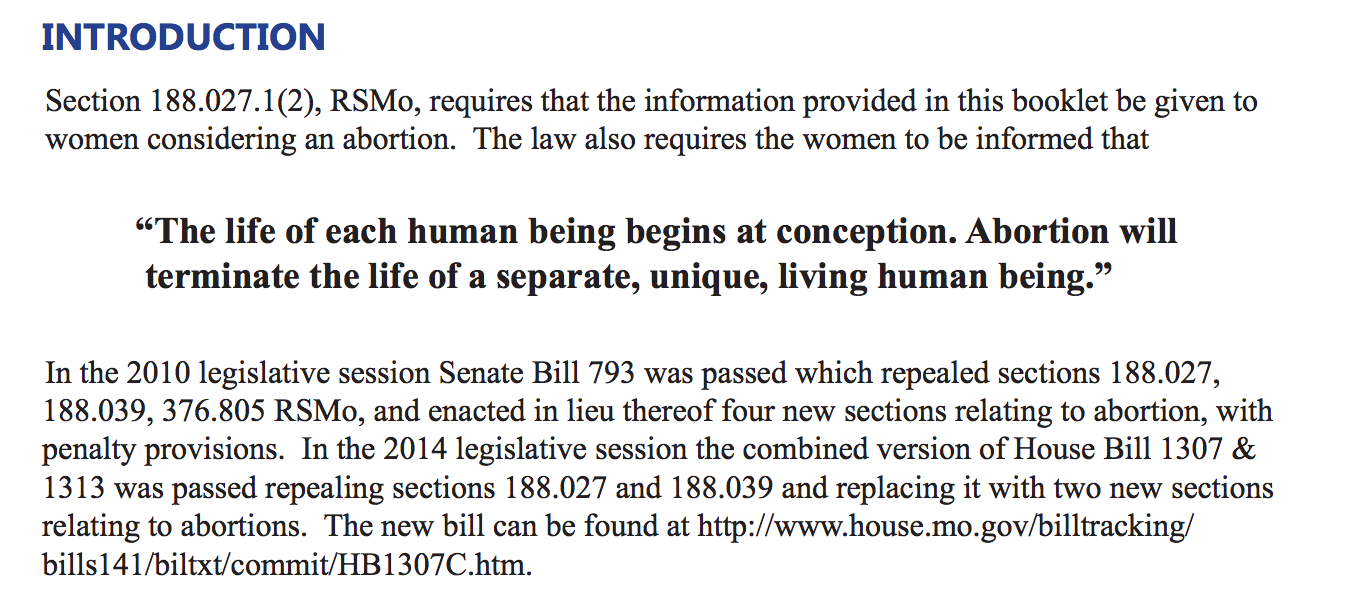
Excerpt from the first page of Missouri’s Informed Consent Booklet
However, according to Mary’s sincerely held religious beliefs, she does not believe that fetal tissue is equivalent to the life of a separate, unique, living human being. According to TST’s appeal brief:
“One of the most contentious philosophical, religious, and political debates of our time is when does human tissue in utero become imbued with sufficient stature as a “human being” to be treated in the same manner as the baby that lives and breathes separate and apart from the mother. The Informed Consent Law expressly adopts and aggressively promotes the Missouri Tenet and thus weighs in on the side of those who believe a “human being” begins at conception and abortion is murder. The Informed Consent Law dictates — by legislative fiat — a definition of “human being,” which the Establishment Clause preserves for resolution solely in the hearts and minds of individuals.”
The individual’s concept regarding personhood is the fractured foundation for many debates regarding reproductive legislation. Beliefs about the beginning of life are purely philosophical and religious in nature. There’s no scientific consensus about this point. In a 2015 Wired article, Scott Gilbert, a developmental biologist concludes, “Science has very little to do with the answer.” Abortion opponents such as former Representative Pratt and others like to use the terms “unborn,” “child,” and “human life,” interchangeably as if they were all the same. But that’s obviously not the case. A fertilized egg isn’t the same as a toddler and the Supreme Court has ruled on this point in Roe V. Wade when the court said that a fetus is not a person but “potential life,” and thus does not have constitutional rights of its own. In fact, the Supreme Courthas refused to hear cases which have sought to define an embryo as a human being from the moment of conception as there is no secular purpose for defining life in this way.
This is where the First Amendment’s Establishment and Free Exercise Clauses come into play, which prohibit the government from making any law “respecting an establishment of religion, or prohibiting the free exercise thereof.” These clauses not only forbid the government from establishing an official religion, but also prohibit government actions that unduly favor one religion over another. They also prohibit the government from unduly preferring religion over non-religion, or non-religion over religion. The Missouri Tenet adopts the religious belief that the life of a human being starts at conception, and in doing so, violates the Establishment Clause. Forcing Mary to comply is clearly an infringement on her sincerely held religious beliefs, and a Free Exercise transgression.
The State has defended its position by claiming that the law merely happens to “coincide or harmonize with the tenets of some religions,” and does not actually promote a religious belief. Clearly, this is an absurd proposition. With no secular motivation to distinguish “when life begins,” the State has made an ethical choice to promote and legislate a particular religious viewpoint. The Court would be grossly irresponsible to ignore this intention.
Representatives for the state have also argued that Mary was not forced to read the informed consent materials, she was only required to receive them. Therefore, her religious rights have not been violated. If this is the case, what’s the point in requiring these materials at all? Further, what’s the point of mandating any law if there’s no expectation of action from citizens? The motivation behind Missouri’s informed consent law is to coerce women into motherhood, and this is made clear by those who proposed and supported the bill:
Mary Doe’s Story
When Mary discovered she was pregnant, she made a decision to have an abortion because it was best for her and her family. There’s only one abortion clinic in Missouri, so she had no choice but to travel several hundreds of miles to the nearest clinic, which she did by bus with her child. She was forced to request time off from work and pay for transportation and a hotel. When she arrived at the clinic, she explained her religious views and presented an exemption form to waive the ultrasound, reproductive booklet and waiting period. However, state law prevented her from obtaining an abortion in accordance with her beliefs.
Instead, Mary was required to pay $500+ and be offered an ultrasound and opportunity to listen to the fetal heartbeat; she was told that life begins at conception, and that abortion is murder. If she maintains her belief, that abortion is not murder, she will be punished — sent away for three days, where she will incur additional costs at a hotel in the hopes that she will feel enough guilt and shame under the state indoctrination efforts to continue her pregnancy. When she returns to the clinic, she won’t be able to have her medical procedure without signing a state-mandated checklist proving that she’s received the reproductive propaganda along with a list of abortion alternatives. After her procedure, she will have to recover while traveling back home with her child and return to work immediately.
Many proponents of informed consent laws like to compare the mandate to their own personal experience with surgical procedures. They might liken it to elective knee surgery in which they were provided time to consider options before scheduling an appointment. The difference here is that the State hasn’t explicitly forbidden them from having the surgery of their choice for any number of days. It also doesn’t force them to undergo a biased counseling session prior to making a choice about their body. In fact, medical ethics standards would forbid it.
This insertion of the State into the communications between physician and patient intrudes on a woman’s autonomy and dignity, interferes with the physician’s professional practice and corrupts the informed consent process.
What does the State Want?
The State claims that the informed consent law and mandated waiting period is in place to help women make difficult decisions and prevent the number of abortions. However, a national survey of abortion patients conducted in 2008 by the Guttmacher Institute found that 92% of women reported that they had made up their mind to have an abortion prior to making an appointment. In a 2014, the Journal Obstetrics & Gynecology published a study of more than fifteen thousand women who visited Planned Parenthood clinics in Los Angeles, and 98.4% of the women who saw their ultrasounds went on to get an abortion anyway. Similar studies have shown that women do not change their minds after viewing informed consent materials.
What about the waiting period? This too is ineffective at reducing abortion rates. In Mississippi, multiple studies have found that the requirement has been associated with a decline in the state’s abortion rates and an increase in the number of residents going out of state for an abortion. The law also forces women to wait longer to terminate their pregnancy, increasing the likelihood of health risks and additional costs. Further studies show that the measure is unpopular among women who reported fewer benefits and more problems from the waiting period than they had anticipated.
If the intention is, truly, to reduce unwanted pregnancies in order to put an end to abortion in America, there are some quantifiable solutions: improve contraceptive access, education and economic prospects. However, none of these measures have been pursued. With this information, it becomes painfully clear that the State’s intentions are purely coercive. The Missouri legislation is intended to promote a religious belief that abortion is murder, and if women seek to obtain an abortion, they should be ashamed and punished.
Mary has clearly suffered as a result of Missouri’s Informed Consent laws. Do we want to live in an America that forces women to suffer unnecessarily under the moral dictates of the State when making personal decisions about their future and wellbeing of their families? Is it necessary to traumatize women in an attempt to reduce abortion rates, when there are so many more effective ways to reduce unwanted pregnancy? Are Mary’s beliefs as a Satanist, albeit untraditional, undeserving of protection under the law? These are the difficult questions we implore you to consider, and we wait in anticipation for the State of Missouri to decide where they stand.
What you can do.
Share this article with others and consider donating to The Satanic Temple’s legal fund. Legal fees for Mary’s case are not pro-bono and have reached the tens of thousands. Donations may be made through The Satanic Temple’s website at: http://bit.ly/2x8hbs7
Oral arguments at The Missouri State Court Western Appellate District will be held on Monday, September 11, 2017 at 10:30am at Missouri Court of Appeals Western District Division 3, 1300 Oak Street, Kansas City, MO.
The United State Court of Appeals for the Eighth Circuit will hear oral arguments on Wednesday, September 20, 2017 at 9:30am before Judges Roger L. Wollman, Michael J. Melloy and Raymond W. Gruender in Division I.
Reproductive Politics in a Post-Truth America
On January 27th, swarms of people descended upon Washington to attend the 43rd annual March for Life. Defined as a “peaceful demonstration to share the truth concerning the greatest human rights violation of our time, legalized abortion on demand,” the march aimed to organize individuals who share a belief that abortion access should be abolished in America. This position is deeply bound to religious beliefs concerning the beginning of personhood, which is obvious when reviewing the March for Life’s roster which included prayer led by Catholic Archbishop Timothy Dolan of New York, a Christian rock band, Bishop Vincent Mathews Jr., president at Church of God In Christ World Missions, and Vice President Mike Pence.
We know how to reduce the abortion rate, but why aren’t we doing anything about it?
Originally published February 21, 2017 on Medium
On January 27th, swarms of people descended upon Washington to attend the 43rd annual March for Life. Defined as a “peaceful demonstration to share the truth concerning the greatest human rights violation of our time, legalized abortion on demand,” the march aimed to organize individuals who share a belief that abortion access should be abolished in America. This position is deeply bound to religious beliefs concerning the beginning of personhood, which is obvious when reviewing the March for Life’s roster which included prayer led by Catholic Archbishop Timothy Dolan of New York, a Christian rock band, Bishop Vincent Mathews Jr., president at Church of God In Christ World Missions, and Vice President Mike Pence.
“Life is winning,” Pence announced, speaking at the Washington Monument, “I believe a society can be judged by how it deals with its most vulnerable. The aged. The infirm. The disabled. And the unborn.” These remarks highlight a view of the “most vulnerable” that seems, at best, selective, and more realistically, grossly deficient. Of course, ending abortion has been a platform issue for the Republican Party from the moment they realized they could use the issue as a catalyst for the Catholic vote. Extreme legislation has continued to pour in with eager sponsors waiting for their Conservative stamp of approval. One radical bill, H.R. 490, was introduced two weeks prior to the march and would prohibit abortion as soon as a fetal heartbeat can be detected, typically around six weeks after conception.
“We think this bill properly applied does eliminate a large, large share of the abortions — 90% or better — of the abortions in America,” said Steve King, the Iowa congressman who introduced the bill.
King’s proposed bill is indicative of deep untruths fueling the anti-abortion movement. “There is no scientific basis for prohibiting a woman from obtaining an abortion whether there is or isn’t a heartbeat present,” Dr. David Eisenberg, a board-certified OB-GYN explained to The Huffington Post. In fact, at six weeks, there’s no such thing as a “fetal heartbeat,” we’re still talking about an embryo, and an embryonic heart is nowhere near a fully developed organ. However, science matters very little to the party that defines a fetus as an “unborn child” within their official platform.
The presumption, made by King and Pence, is that the implementation of anti-abortion legislation will decrease the number of abortions in America, thus protecting the most “vulnerable” in our society. However, this too is misleading. A 2012 analysis of global trends conducted by the World Health Organization and the Guttmacher Institute found that, criminalizing abortion does not reduce the number of terminations women have. For example, in countries where abortion is legal, 34 women in every 1,000 terminate an unwanted pregnancy. In countries where abortions are always illegal or legal only if a woman’s life is in danger, 37 women in every 1,000 have the procedure. In short, abortion restrictions do not have a significant impact on reducing abortion. Restrictions do, however, make the procedure more dangerous. So dangerous that on average 47,000 women die each yeardue to unsafe abortions; these lives, nevertheless, do not seem to qualify for room under Pence’s moral umbrella.
The policy appears to have very little to do with research, or with facts. “This administration will work with Congress to end taxpayer funding for abortion and abortion providers, and we will devote those resources to health care services for women across America,” Pence declared to the crowd gathered for the anti-abortion march.
In reality, using taxpayer dollars to pay for abortions has been illegal since 1976 with the passage of the Hyde Amendment, which prohibits Medicaid from paying for abortions except in the cases of rape, incest, or if the mother’s health is endangered. In fact, The Hyde Amendment funding restrictions apply to abortion services both in the United States, and overseas, which is why White House spokesman Sean Spicer’s justification of President Donald Trump’s reinstatement and expansion of the Mexico City policy (which requires non-governmental organizations to “agree as a condition of their receipt of federal funds” that they would “neither perform nor actively promote abortion as a method of family planning in other nations”) as “respecting taxpayer funding” makes little sense. That justification falls apart even more when we consider the fact that, while taxpayers do not provide funding for abortions, they do fund pregnancy related care for medicaid recipients. In 2010, this cost totalled $21 billion; investing in family planning programs, and providers such as Planned Parenthood, actually resulted in a savings of $13.6 billion. The truth is, defunding successful family planning services is a burden on taxpayers (especially poor taxpayers), rather than a relief.
If the intention is, truly, to reduce unwanted pregnancies in order to put an end to abortion in America, there are some quantifiable solutions: improve contraceptive access, education and economic prospects. In fact, abortion in America is currently at its lowest quantifiable point since Roe. v. Wade, and while the anti-choice movement often attributes this to the effectiveness of anti-abortion legislation, data shows that this is not the case. The way to “save our most vulnerable,” is to provide people with birth control and teach them how to use it; this is why the abortion rate has declined in tandem with better access to birth control while the birth rate hasn’t increased. Even more telling is the disproportionate amount of unintended pregnancies among minority communities. An African-American woman is nearly five times more likely to have an abortion than a white woman, and the Hispanic rate is double that of whites. According to a 2011 study of “Disparities in Family Planning” from the American Journal of Obstetrics & Gynecology, minority and low-income women are less likely to use contraception and have higher rates of contraceptive failure. While low income and lack of education are associated with increased risk of unintended pregnancies. The study proves that disparate access to reproductive education, economic opportunity, and medical care has a profound impact on the rate of unintended pregnancies and abortion.
While complicated, these data points are not debatable. The medical community has provided actionable, informed directives regarding effective solutions to reduce the abortion rate in America. Remarkably, legislators continue to propose policies contrary to this evidence. The Republican party has made defunding the nation’s largest provider of birth control a number one priority and has allocated over $1.5 billion dollars to ineffectiveabstinence-only programs. In fact, only 18 states require instructors to provide information about contraception to students and only 13 states require that sexual education courses must be medically accurate. These factors easily contribute to the United State’s teen pregnancy rate, which is the highest of any other developed country.
In 2009, Pence himself voted against the Lilly Ledbetter Fair Pay Act which aimed to protect women and minorities from wage discrimination, adding to his history of opposing minimum wage increases. Pence asserted that the bill was “anti-minority” due to the unsubstantiated claim of lost minority jobs following a wage hike. Not a single major anti-choice organization works to improve contraception access and education, in fact most are completely silent on the issue if not vocally opposed. At every turn, legislators and anti-choice organizations contradict themselves. While they claim to oppose abortion, they completely refuse to take steps proven to reduce the abortion rate, opting instead for costly, ineffective and oppressive laws that do little more than boost their credentials among religious, Conservative voters.
Those of us who support neutral, fact-based legislation have done a poor job of holding our representatives accountable for perpetuating inaccuracies to appease a radical religious sect. Abortion is the ultimate “post-truth” political issue. The Oxford English Dictionary defines post-truth politics as a state of discourse in which “objective facts are less influential in shaping public opinion than appeals to emotion and personal belief.” For decades, the abortion debate has been framed by these appeals to raw emotion, refusing to acknowledge the realities created by anti-choice legislation. Proponents of anti-choice legislation do not deal in facts, preferring instead a pathos which drowns out any data. While we can accept and respect an individual’s right to oppose abortion on religious or moral grounds, we cannot hold everyone to that singular position. The belief that personhood begins at conception, is a philosophical viewpoint, rather than a scientific fact. Medically speaking, life is a process not an event, and a fetus is not yet a “person,” even if it is human. The value of fetal life and the life of a woman is a matter of opinion (which has varied drastically throughout history), not a scientific truth. Fortunately, America is not a theocracy and the Establishment Clause of the Constitution requires our government to remain neutral in regards to religious matters. We are to trust experts, invest in research, and implement policies based on fact, not religious opinion. If our legislators are unable to disentangle their religion from their duty and responsibility to uphold the Constitution, then they must choose a different profession.
Reproductive freedom and religious liberty are fundamental rights. However, I do not have the right to make family planning decisions for others, and the local church does not have the right to enforce their religious conceptions of the self or other ideologies of personhood on me. Our elected representatives are not surrogates for the church, despite the effectiveness of this illusion in motivating religious, or single-issue voters. Although both Democrats and Republicans employ the abortion issue to sway the electorate in one direction or the other, very little has been implemented to improve reproductive health care access, or reduce unwanted pregnancies. While abortion is certainly polarizing, in part because it is tied to individual beliefs regarding the value and meaning of life, it doesn’t hold a torch to the depth of reproductive and sexual health care that impacts every single American, every single day, and enjoys very little reform.
We can no longer tolerate post-truth rhetoric to justify harmful, economically irresponsible, healthcare legislation. It’s pointless to fall into a trap of debating the value of life, or the definition of the “unborn,” as so often happens on taxpayers’ time on the House or Senate floors. If the problem is with abortion, then we need to take steps to reduce it as proven by countless studies on a global scale by implementing policies to ensure that all women have equal access to education and medical care necessary to make informed decisions about family planning regardless of socioeconomic status, or race/ethnicity. If we are serious about family planning, and can agree that reducing unwanted pregnancy is better for our society, than nothing should stand in our way of reaching across the aisle and working together with others to reduce abortion effectively, regardless of when you believe “life begins.”
I encourage you to call your anti-abortion representative and tell them that you are concerned about the rate of unwanted pregnancy in America, especially the disproportionate number of abortions in poor and minority communities. Ask them about comprehensive sexual education reform, and urge them to ensure continued affordable contraception access under Medicaid. If you are met with a refusal to take these basic steps, on philosophical or religious grounds, you have proven the underpinnings of the national debate. Abortion serves as a powerful political smokescreen and a proxy for religious morality, as defined by a political group to manipulate vulnerable, religious constituents. If the Republican Party is championed as “defenders of morality,” than it grants them permission to behave immorally without being held accountable by those single-issue voters. If they truly wanted to invest in protecting “unborn lives,” it would be done. However, the power of polarizing the electorate over fabricated moral dilemmas is too tempting to resign. The rallies are too powerful as a political soapbox; the voting directives from pro-life organizations are too beneficial in an election; and the anti-abortion industry continues to collect donations to perpetuate the whole, pointless machine. When Mike Pence shouts “Life is winning!,” at the Washington Monument what he really means is that he is winning. This is about power, and all of us, even “the unborn,” suffer as a result.
Hold your representatives accountable, educate your community, and work with others to offer proven solutions. Your future, and the futures of those around you depend on your participation.
Find your elected officials
National Right to Life U.S. House Scorecard (2015–2016)
National Right to Live U.S. Senate Scorecard (2013–2014)
On becoming Unmother
I am in the process of planning my abortion. It seems strange to say it like that but it’s true. I’m currently pregnant and planning my abortion which should happen roughly one week from now. I’ve never been pregnant before, so I’ve never needed to make these kinds of arrangements. That doesn’t mean I haven’t thought about it. In fact, I’ve thought a great deal about abortion, and pregnancy, and the legal and moral implications surrounding such a situation. You see, I’m of the opinion that people should be able to manage personal decisions about their health and their future without the imposition of government regulations. The moral and philosophical opinions of some don’t always work for the rest.
Originally published on Medium
November 2015
I am in the process of planning my abortion. It seems strange to say it like that but it’s true. I’m currently pregnant and planning my abortion which should happen roughly one week from now. I’ve never been pregnant before, so I’ve never needed to make these kinds of arrangements. That doesn’t mean I haven’t thought about it. In fact, I’ve thought a great deal about abortion, and pregnancy, and the legal and moral implications surrounding such a situation. You see, I’m of the opinion that people should be able to manage personal decisions about their health and their future without the imposition of government regulations. The moral and philosophical opinions of some don’t always work for the rest. I think it’s deeply strange to police the most intimate spaces of our lives. When you breed and whom you take to bed is personal. If we are forced to distort our internal lives, we sacrifice the totality of our selves.
The imposition of a single moral criterion upon our collective bodies is noxious. This is why I will not take the time to pick apart the abortion debate in an attempt to persuade others to my personal perspective. I know that no amount of rational rhetoric or comparatives will convince someone opposed to my position. I will simply say that I respect the choice of others, no matter how they’ve arrived at it so long as I’m provided space to make my own. Living within a country comprised of a diversity of experiences and faiths, we must collectively agree to make compromises to protect our capacity to make personal decisions in accordance to our own beliefs. Once we begin to enact moral legislation dictating who we may sleep with, or marry, or how and when we become parents, we fundamentally change what it means to be “free.” Once we dissolve and exploit the meaning of murder, of motherhood, and of the woman to benefit a moral agenda we lose sight of the substance and significance of these concepts.
I am one woman sharing the experience of millions. The fear of unplanned motherhood has plagued women since the dawn of humanity. References to abortion have been part of the written record since the dawn of the record itself. The earliest reference to induced miscarriage appears in the Ebers Papyrus, an Egyptian medical text written in about 1550 BCE. The bible itself details a recipe for the abortion of a child conceived by an unfaithful wife (Numbers 5:11–22). It wasn’t until the mid-19th century that it became a crime. Despite the history and frequency of abortion within the annals of humanity there is virtually no record of the female experience. Perhaps we can attribute this to the omission of women’s voices from history generally, but what about in the last century, or decade?
The collective silence reeling through space falls heavy on pregnant women. Despite the taboo, many groups have encouraged women to engage in public discussion about their abortions to illuminate and demystify the experience. This is sorely needed. Silence grants power to those who wish to stigmatize the act and shame the actor.
This is why I am writing about my pregnancy experience. I have written a daily entry from the moment I discovered I was pregnant and will continue to do so through the termination process. We so often focus on the abortion itself without considering the nuances of the entirety of the experience — the surreal moments between motherhood and unmotherhood. How does an uninsured woman in Detroit navigate the legal implications to terminate her pregnancy safely and affordably? The resources available to someone in my position are sparse and often confusing, even for someone who has spent the last year researching the topic.
I will not offer rationale for my decision because I do not seek approval. The entries are written solely from my internal, personal perspective as much a process of self-examination as it is a public record. Following the termination of my pregnancy, all entries will be archived and the website will serve as a resource to help others navigate the often complicated legal and medical system in Michigan. It is my hope that this action will fracture a vacuum of silence and provide clarity to the experience of unmotherhood.
Visit the website: crisispregnancymichigan.com
Port Huron 'hell house' mixes fright and faith with questionable results
I found myself holding the hand of a 13-year-old girl in a pitch-black corridor awaiting entrance into the House of Judgment, an evangelical haunted attraction called a "hell house" that aims to “scare people for Jesus.” By all appearances this is your typical small-town haunted house, featuring the sounds of shrieking women, enough strobe lights to give anyone a full-blown seizure, and a jittery gaggle of pubescent teenagers squirming in anticipation of a good fright. However, clearly unknown to some (specifically the chain-smoking baddie wearing the "HIGH AS FUCK" beanie and his young crustachioed comrade), this horror house has a mission of salvation.
Originally published in the MetroTimes
October 2015
I found myself holding the hand of a 13-year-old girl in a pitch-black corridor awaiting entrance into the House of Judgment, an evangelical haunted attraction called a "hell house" that aims to “scare people for Jesus.” By all appearances, this is your typical small-town haunted house, featuring the sounds of shrieking women, enough strobe lights to give anyone a full-blown seizure, and a jittery gaggle of pubescent teenagers squirming in anticipation of a good fright. However, clearly unknown to some (specifically the chain-smoking baddie wearing the "HIGH AS FUCK" beanie and his young crustachioed comrade), this horror house has a mission of salvation.
My new friend timidly leans in after a brief pinky squeeze and whispers, "I hope it's not too scary." I nod, but before I'm able to reassure her, we're escorted into a sweaty room fashioned in the style of a Victorian-era parlor illuminated by only the Cheetos-gold glow of flickering faux-candelabras. A pale-faced dad shrouded in a cloak emerges from the shadows and greets us.
"Welcome to Judgment House." He bellows. "First, a few rules. Number one, absolutely no swearing. Number two, do not take the Lord's name in vain."
A teenage boy of about 15 scoffs at the rules under his breath, still staring at the glow of his screen. Our guide turns to him and asks him to turn off his phone as we're shuffled onward to the scene of an old apartment. In his best Vincent Price, our guide demands we line up against the wall of the room — but snaps out of character to reprimand the defiant boy in the group for swearing.
The two argue for a moment, and the boy walks onto the set and out an open door. Our guide throws up his arms and tells us the show is over due to our "inability to follow the rules." After a few shouts from behind the set, the back wall of the room lunges forward and collapses at our feet. The defiant boy is bloody and crucified to the wall. Our visit through the House of Judgment would follow his journey through hell.
The following 20 minutes depicted the horrific future in store for those who dare to have a potty mouth, which was similar to imagery found in secular haunted houses presumably in an attempt to tap into the potential range of fears held by visitors. Between each new room we were instructed never to "stray from the path" in some holy attempt at subconscious programming. Children around the age of 8 nipped at our ankles and giggled like the little Christian demons they are and led us into the "pit of hell" — a cartoon version of the underworld, complete with a horned tomato-red man who declared us all sinners.
Next, an aggressive werewolf questioned each of us about our desires for the afterlife, shaming those laughing at the spectacle. "You think hell is funny?" he growled. "Hell is real. Only a fool would choose hell over heaven!"
On that cue, a door opens to a room where a boy in a loincloth hangs from a cross. In one fell swoop the face of all teen horror addicts are distorted into disappointment and confusion. Channeling Passion of the Christ, Jesus heaves a deep breath and mutters, "I forgive them," and collapses.
Before given an opportunity to process the salvation-scam, the exit door is flung open, an angel exclaims "He has risen!" and biblical booklets are shoved in our hands as they usher us out the door.
Once outside, the teens run off into the night, seemingly unaffected by the attempt to scare them straight. Many of them toss the book in the trash down the block. The fact is, Teen Wolf was right: Horror and hellfire was the best part of the whole show. Once they brought Jesus into the equation, it ruined everyone's good time.
While the supple minds of the youth are certainly intrigued by traditional Hollywood horror, Grace Baptist Ministry — the church behind The House of Judgment — fails to realize that even teenagers have a more sophisticated understanding of eternal damnation as to not be driven into the "arms of god" by the local cast of Joseph and the Amazing Technicolor Dreamcoat prancing around to the Nightmare on Elm Street soundtrack. If anything, the message of manipulation and fear-mongering from the church was enough to scare even some of the most naïve of the group — not into the arms of Christ, but away from the church altogether. I chalk this one up as a win for the sinners.
The Religious Candidate Mandate
Religion fanaticism defies the logical framework most of us subscribe to. This makes it incredibly difficult to communicate with the devout reasonably. Two plus two equals five, it’s as simple as that — the solution is in the good book and that’s all that you need to know. So when it comes to a secular democratic government, which has promised to protect us from religious oppression and ensure our right to religious freedom, we face an interesting dilemma.
Originally published on Medium
August 2015
Religion fanaticism defies the logical framework most of us subscribe to. This makes it incredibly difficult to communicate with the devout reasonably. Two plus two equals five, it’s as simple as that — the solution is in the good book and that’s all that you need to know. So when it comes to a secular democratic government, which has promised to protect us from religious oppression and ensure our right to religious freedom, we face an interesting dilemma.
In order to maintain religious freedom, the government must allow practice of all faiths equally. This is necessary to ensure that the ethical and moral implications as defined by one religious doctrine are not favored over others. The government must also ensure that each of its citizens is provided an opportunity to exercise one’s faith so long as it does not defy the law or interfere with other’s basic rights to life and liberty.
If you happen to be a religious person who works as a politician, then it is your fundamental task to uphold the laws of the constitution as we have agreed upon as a nation. It is possible that in favor of protecting our constitutional rights, one might have to suspend certain religious beliefs specific to their personal faith in favor of allowing each citizen the freedom of making ethical faith-based decisions on their own.
The icons and laws of religion must therefore differ from the icons and laws of the state (or remain justified on ethical grounds rather than religious). For example, religious symbols are required to stay within the confines of one’s personal property or on property designated for worship. This way, citizens are able to practice their faith on a personal or communal level of like-minded believers without marginalizing fellow citizens who may not share the same beliefs.
THE POLITICIAN’S PROBLEM
If the law requires you to ignore principles of your faith in order to maintain the laws of the constitution but that request is so absolutely against the ethical principles of your religion — how could you, ethically uphold the constitution? Is the constitution an immoral document in and of itself or does it merely protect the rights of citizens to act morally according to their own selves? Building a platform in the role of “moral protector” presupposes that everyone must share the same moral code — that the things that are wrong for one person are wrong for all people. On the other hand, by endorsing a law that allows others to make decisions you consider unethical means that you yourself may have behaved unethically in accordance to the laws of your faith.
THE FAITH-BASED SOLUTION V. CONSTITUTION-BASED SOLUTION
In order to enact a religious law as actual law, you must force your citizens to disregard their own faith in favor of state approved faith-centric ethics, or assume that all citizens share in the religious beliefs of the state. This is the first violation of the constitution (specifically the Establishment Clause). However, forcing people to pay taxes that support services that they deem unethical due to their faith does not violate the laws of the constitution. This is because the constitution is a document that protects the best interest of the nation, rather than the spiritual opinions of some (or even the majority). Instead, it provides us the individual right to make decisions based on our moral or ethical code, religious or not. State tax does not force someone to participate in “sinful” activities. Rather taxes support our right to make these decisions on our own, regardless of faith. Unless of course, you live in the year 2015, when faith-based privileges and exemptions are being granted to a select few — leaving others without access to basic resources, and marginalizing the religious, or ethical beliefs of others.
THE FAITH-BASED SOLUTION FLAW
The foundation of recent religious liberty debates is the idea that forcing businesses to financially support activities deemed “sinful” in their particular faith is a violation of the First Amendment. If this argument was to hold up, we would have to put an end to use of taxpayer moneys for all functions deemed contrary to one’s faith. One that specifically comes to mind is tax funded weapons and warfare, another is the death penalty. So while the religious demand exemption from certain taxes in accordance to their faith, they remain inconsistent with either their moral compass or are utilizing their faith to push a specific agenda.
THE RELIGIOUS CANDIDATE MANDATE
The majority of citizens demand, or have come to expect that our political leaders belong to a certain faith. In the minds of most voters, a suitable political leader is one with a strong moral, ethical and spiritual foundation. While they may share several of the same traits by default, the job of enforcing the moral framework of a community or acting as a moral role model is the job of a priest- not that of a politician. Instead, we have a political system, made up of various individuals who are tasked with something fundamentally very simple — to uphold the constitution and represent the voices of the people. Accepting that there is a growing number of individuals who do not subscribe to Christianity in this country, and that the constitution is drafted in part, to protect those individuals, I believe we have a problem.
If politicians must subscribe to the dominant faith in America to have any hope of being elected, and we demand that they remain morally and ethically accountable to their faith than we cannot also demand they protect the rights of the constitution or of others who of alternative systems of belief. A person who functions within a religo-logic domain will never favor the constitutional rights of others over their personal religious dogma. So politicians veer in one of two directions, they vote to reject the rights of citizens in order to maintain a moral landscape defined by their religion (and to appease a specific majority faction of voters) or they vote to uphold the constitution and face criticism by religious constituents who are often the most vocal.
IT’S NOT CHURCH V. STATE — BUT CHURCH AND STATE
The church has its own very specific function within our community and likewise, so does our government. The government protects our rights and freedoms. The church offers us moral guidance for our personal lives. If one begins to take on the roles of the other — the state providing moral guidance mixed in with the function of making laws — than we have a major loss and a major flaw. Who is protecting our rights? If the church began upholding the constitution where would we go for moral guidance? Demanding that the two function the same diminishes the power of both.
A FINAL NOTE
The American republic takes pride in the freedoms protected by the constitution. It is popular to distinguish our country from those who suffer from the tyrannies of dictatorship and of theocracy, countries whose legal system and regime are rooted in religion. In these places, clergy serve as political figures that aim to uphold religious law for the supposed prosperity their country and their leader. As history has shown us, these regimes use religious mandates to justify widespread limitations of the kinds of freedoms we have proudly defined ourselves by.
It is a shame that a large majority of the American population believes that we, as human beings, are incapable of being moral without religion. Yet, I fear that this is a concept requiring a great deal of debate to dismantle. That being said, if we elect our political leaders based on their faith, then we must do so with acceptance and mutual understanding that at times they will have to suspend their own beliefs in order to do the job we elected them for. If we are unhappy with their decisions and consequently vote for a religious representative who will consider first his loyalty to the church, and second to the country — then we are on our way to losing the freedoms that make us unique. We cannot have it both ways. If a politician finds it morally incomprehensible to vote in a manner that upholds the guidelines of the constitution, then they are much better served as a member of the clergy.
At this moment, we are faced with this very dilemma. If we still hold dear the right to speech, press, petition, assembly — and yes, even religion, then we must demand and accept that our government remains secular, our public life remains faith-neutral, and our private lives and our faith-based communities remain a place for religious practice. We must all make compromises to co-exist within a fair, respectful and just nation. Imposing the religious ideology of a majority group does a disservice to us all.
Senator Jones, 'Religious Liberty' also applies to Satanists
In a recent interview, Michigan Senator Rick Jones claimed that The Satanic Temple of Detroit is a reason you should support the Michigan Religious Freedom and Restoration Act (MI-RFRA). Exploiting fears of history’s most infamous scapegoat, the Senator is swooping in to offer MI-RFRA as protection from the local baking enterprises from Michigan’s Satanic community: “…if a man has a bakery and he bakes cakes for a living and the Satanic Temple of Detroit comes in and says, ‘I want you to make a satanic cake with a big snake and other symbolism and he says, ‘I simply can’t do that because of my religion.’ He should have the right to say no.”
Originally published on DailyKos
March 2015
In a recent interview, Michigan Senator Rick Jones claimed that The Satanic Temple of Detroit is a reason you should support the Michigan Religious Freedom and Restoration Act (MI-RFRA). Exploiting fears of history’s most infamous scapegoat, the Senator is swooping in to offer MI-RFRA as protection from the local baking enterprises from Michigan’s Satanic community: “…if a man has a bakery and he bakes cakes for a living and the Satanic Temple of Detroit comes in and says, ‘I want you to make a satanic cake with a big snake and other symbolism and he says, ‘I simply can’t do that because of my religion.’ He should have the right to say no.”
Despite adamant refusal to concede to claims that the bill could provide a “license to discriminate,” Senator Jones claims the initiative will protect an individual’s religious liberties unless of course it’s the religious liberties of people such as members of The Satanic Temple of Detroit, or others who offend normative religious sensibilities. In fact, historically speaking there’s never been a single “religious liberty” claim in the courts that hasn’t explicitly involved limiting someone else’s rights. In Michigan, there was no discriminatory infraction or call to action by the citizens of the state due to some impending government stranglehold on the religious liberties of Michiganders, unless you consider providing protections for the LGBTQ community a sign that our religious freedoms are under fire. However, that’s precisely the argument from Republican House Speaker Jase Bolger who introduced the bill as a way “balance” the rights of religious people in response to an amendment to add both sexual orientation and gender identity to the state’s Elliott-Larsen Civil Rights Act, a nondiscrimination bill that’s now been considered “dead” due to a refusal to include members of the transgender community in the legislation. So while the legislature is on a crusade to safeguard the “freedoms” of a religious majority, they find it morally incomprehensible to consider basic civil rights protections for marginalized individuals, many of them Christians themselves. In an oh-too-typical inversion of the victim-oppressor dynamic, a federal law initially designed to protect the religious minority is turned on its head. The LGBTQ community has become the bully, while Christians are painted as oppressed victims.
In case you’re unfamiliar with MI-RFRA, the bill would protect people from laws that substantially burden their sincerely held religious beliefs unless the government can prove that the offending law serves a compelling interest and accomplishes that goal using the least restrictive means possible. Representative Bolger claims that the law cannot be discriminatory because it’s meant to exist between an individual and a government action, not between two individuals like, for example, the religious pediatrician and a patient with same-sex parents. However, that’s exactly what the bill permits. MI-RFRA would enable businesses to effectively “opt out” of laws that would, say, forbid discrimination based on things such as gender identity and sexual orientation. In an open letter to the press, Ari Alder, spokesperson for Rep. Bolger defended the bill claiming that “opportunists” have suggested “people will suddenly be able to ignore existing laws (which is) nothing more than scaremongering tactics without any basis in reality.” However, it seems the “opportunists” are in his own camp, making claims in favor of disregarding basic civil rights protections and exemptions to public accommodation laws by means of RFRA.
Let’s consider the illustration proposed by Senator Jones regarding a deeply offensive Satanic cake order. It’s true that businesses have the right to refuse service to customers for a number of reasons such as when a patron endangers the safety and well being of other patrons, is lacking adequate clothing or the business is at capacity. However, due to a little thing called the Civil Rights Movement and the resulting Federal Civil Rights Act, all people have the right to “full and equal enjoyment of the goods, services, facilities, privileges, advantages, and accommodations of any place of public accommodation, without discrimination or segregation on the ground of race, color, religion, or national origin,” which means denying service to the Satanist due to his religious-themed cake would be a violation of the patron’s civil rights. But isn’t the bakeshop private property? Yes, however, because the shop’s primary purpose is to serve the general public, it is also considered a place of “public accommodation,” which requires susceptibility to equal protection laws. Therefore, private property does not excuse unjustified refusal of service. Further, according to the Supremacy Clause of the United States Constitution, the state RFRA law cannot trump the Federal Civil Rights Act. Does that mean that the Civil Rights Act will go unchallenged? Of course not. In fact many people have attempted to challenge the Civil Rights Act on the basis of one’s faith, including segregationists in the 1960’s who claimed that racial segregation was a “gift from God.”
While the free exercise of religion is one of many civil rights, it may not necessarily trample on the rights of another. In a conflict, the courts take on the burden of valuing one civil right over another. In the case of a Christian pediatrician who refuses to care for the child of same-sex parents, the pediatrician would have to prove that providing services to the child severely violates a deeply held religious belief if taken to court. Now, in Michigan, same-sex couples are literally afforded no protections under the state’s civil rights act, but let’s just pretend our legislature has grown up at least as much as Utah circa March 2015. Unless the Bible has undergone a recent revision, there is no Christian teaching forbidding one from caring for individuals associated with practices that might be considered biblically reprehensible. If this rule were to be applied, would it be permissible to turn away the child of an unmarried mother? What about a Jewish family? Nobody is asking the pediatrician to approve of same-sex parenthood, nor to endorse homosexuality, so where do we draw the line? Is caring for patients as a career a religious act at all? The pediatrician is operating as a commercial agent, selling health care to paying patrons. Just like all commercial businesses open to the public, the establishment is subject to certain federal regulations, such as labor laws, environmental laws, tax regulations and non-discrimination laws, regardless of whether the doctor, or employer disagrees with them. If an individual finds that abiding by secular civic law is ethically problematic, perhaps that individual should choose a profession outside of public service. However, once you take on a position that serves the public, one may occasionally have to sacrifice engrained superstitions in order to accommodate the diverse community which welcomes your business, the legal protections provided to them, as well as mandated regulations that are intended to ensure that our communities function both safely and fairly.
Despite the Senator and his colleagues’ wet dreams, MI-RFRA cannot exclusively “protect the religious freedoms” of a single faith. It must accommodate the religious beliefs of all citizens. Therefore, The Satanic Temple does not consider the bill a threat to our activities, but an opportunity. We’d like to be very clear here: if RFRA passes we have every intention of taking full advantage of the provisions it may provide to protect our sincerely held religious beliefs from biased faith-based initiatives unjustly imposed by our government. Unlike the segregationists and the Senator, The Satanic Temple of Detroit has no intention of utilizing MI-RFRA to discriminate against others whom we disagree with, but to utilize the bill to ensure our voice and opinion has equal footing within the law. In fact, as a gesture of clarity and respect for the time and resources of our courts, who will inevitably be charged with the responsibility of arbitrating the countless number of cases brought before them, The Satanic Temple of Detroit has made signs available online for print-up that both allow for businesses to specify who they discriminate against, or, if they have a non-discrimination policy in effect. The signs, available at on the Detroit Satanic Temple website read:
“Due to sincerely held religious beliefs, No service for: (fill in the blank),” and a second sign displaying the words: “Due to sincerely held beliefs, All are welcome.”
Additionally, we’ve begun a petition advocating for an amendment to the MI-RFRA bill, which would legally require businesses that accommodate the public to post any discrimination policy in effect in a conspicuous location visible to patrons and employees. We believe that it would be better for everybody involved if businesses and services were completely transparent regarding their positions on discrimination.
Contrary to Sen. Rick Jones’s disingenuous ‘baker’s rights’ fantasy, The Satanic Temple is neither the cause nor a sensible justification for passing the MI-RFRA bill. However, if in his transparent zeal to legalize anti-homosexual discrimination, the Senator manages to see the bill passed, we will make certain we are counted among its beneficiaries.
(2014, November 13). House Bill 5958. Retrieved from http://1.usa.gov/...
Alder, Ari. (2014, December 15). PRO Religious-freedom act would protect Michigan people of faith. Retrieved from http://bit.ly/...
Foltin, Richard T. (2013) Reconciling Equal Protection and Religious Liberty. Retrieved from http://bit.ly/...
Holland, Alana. (2015, February 25). Lawmakers weigh in on religious freedom bills. Retrieved from http://bit.ly/...
Michaelson, Jay. (2013, March). Redefining Religious Liberty. Retrieved from http://bit.ly/...
Millhiser, Ian. (2014, February 26). When ‘Religious Liberty’ Was Used To Justify Racism Instead of Homophobia. Retrieved from http://bit.ly/...
Oosting, Johnathan. (2015, January 22). Religious freedom bill returns in Michigan Senate. Retrieved from http://bit.ly/...
———. (2014, December 3). ‘Historic’ gay rights hearing ends without vote on Michigan anti-discrimination proposals. Retrieved from http://bit.ly/...
Phillip, Abby. (2015, February 19). Pediatrician refuses to treat baby with lesbian parents and there’s nothing illegal about it. Retrieved from http://wapo.st/...
GLOBAL IMAGINARIES, INDIVIDUAL REALITIES
Technological progress has radically transformed the ways we experience life. Our social and cultural interactions are no longer exclusively limited by our physical proximity to one another but are shared through a global network of diverse interconnected communities. Blurring geographic boundaries that have traditionally defined nations and peoples, the digital revolution has forged a new vision of the “global village” that assumes that all people share a common destiny. This concept challenges us to negotiate our place within this imagined community in consideration of our own personal experiences as members of actual families and neighborhoods, with real ethnic and cultural histories.
September 2014
Technological progress has radically transformed the ways we experience life. Our social and cultural interactions are no longer exclusively limited by our physical proximity to one another but are shared through a global network of diverse interconnected communities. Blurring geographic boundaries that have traditionally defined nations and peoples, the digital revolution has forged a new vision of the “global village” that assumes that all people share a common destiny. This concept challenges us to negotiate our place within this imagined community in consideration of our own personal experiences as members of actual families and neighborhoods, with real ethnic and cultural histories.
These developments have fundamentally altered the ways in which we envision our world, creating new lenses to negotiate our most basic human needs for self-understanding, social participation, companionship, expression, and independence. Creative expression, an enduring marker of the human narrative, persists as a one of our most powerful tools to navigate the imaginary. As an external product of the internal self, art provides us with a language to express our understandings of realities that otherwise may be left unspoken.
DISCUSSION
The fabric of our social world is constituted by the unseen. The physicality of the material world provides a framework central to the functioning of life, yet the construction of our internal realities and of our external relationships to those around us transcends the observable. This truth is a product of the human condition. At our core, we are internal and reflexive, emotional, conceptual and creative. Our inherent drive for understanding enriches the experience of life and manifests itself within the social sphere, inspiring a forum for exchange and communal organization. The prosperity of a community is dependent on the tools its members utilize to internally negotiate and facilitate this exchange of meaning. Verbal and textual discourse alone fall short of clarifying our deeply abstracted and diverse truths, and it is here that creativity reigns.
Occupying the place between the physical and the imagined, art parallels the condition of our world and provides a language for which to navigate the imperceptible bonds that construct our reality.
The creation of art is a vital part of what makes us human and as a uniquely human product, it is deeply entwined within the primary pillars of society. From the walls of cave dwellings to the facades of antiquity’s great stone monuments, the role of the aesthetic as a conduit for political, social and cultural expression has been an enduring characteristic of art since its inception. Fluid and adaptive, our visual language endlessly evolves as we do, persisting as a poignant commentator; it is an enduring marker of reality and time.
Contemporary art has endured as a salient social critic from Picasso’s Guernica (1937) to Motherwell’s Elegies (1948-1967), and beyond. To explain his symbolism in Guernica, Picasso remarked, “It isn’t up to the painter to define the symbols. Otherwise, it would be better if he wrote them out in so many words! The public who look at the picture must interpret the symbols as they understand them.”1 Herein lies the brilliance of art, as it timelessly persists both as personal and universal, becoming a transmitter of an ever-evolving meaning and a relentless marker of an evolving human consciousness. Within the exchange between the visual and the subliminal, the artist and the viewer, and conscious and the subconscious our worldview is challenged and molded.
Art of the 21st century is marked by an aesthetic shift away from depicting the illusion of a visible reality. Diverging from the formal artistic tradition, contemporary art is defined by its abstract and symbolic representations. As a product of the human experience, we cannot dismiss this shift as an arbitrary trend in creative experimentation but rather as an illumination of the modern condition. As our world becomes increasing complex and symbolic, so too does the art from within it. With the rise of globalization assisted by great innovations in technology, the constellations of the economic, political, cultural and social spheres have become progressively porous. Challenging tradition, these advances create a tension between the past and the present, forcing us to redefine our conceptions of identity and community. The social imaginary describes the invisible, cohesive fibers of the social world in which we collectively envision, understand and legitimize our shared experience. Although these imaginary bonds are a permanent part of our social history, the form in which they take is ever evolving as our collective imagination redefines what these are. As our individual realities become less tangible or immediately perceptible, the social is no longer determined by our proximity to one another, and our identities are no longer predicated by the physical but rather by our individual internal selves. How are we to navigate these multi-leveled realities? Could it be now that art, as a conveyor of meaning and truth and as an impetus for action – is the language most eloquent and best adapted to this abstracted modern condition?
1 “Guernica”, Guernica: Testimony of War. Treasures of the World, PBS Online. (1999), accessed November 8, 2012.
REALITY IS RAPTURE // COMMIT VIRTUAL SUICIDE
You and I are witness to the dawn of a new reality. For the first time in the history of humanity we are observing a radical transmutation in the ways in which we experience existence. The Digital Revolution, defined by the modern achievements in technology and development of the global information society, has dramatically transformed the way in which mankind functions. Each of us has experienced the effects of these changes and many have happily adapted to the new order as advocates of the improved life. This is the birth of the posthumanist man at the crossroads of the natural and the invented.
June 2012
You and I are witness to the dawn of a new reality. For the first time in the history of humanity we are observing a radical transmutation in the ways in which we experience existence. The Digital Revolution, defined by the modern achievements in technology and development of the global information society, has dramatically transformed the ways in which we functions. Each of us has experienced the effects of these changes and many have happily adapted to the new order as advocates of the improved life. This development has signaled the birth of the post-humanist person at the crossroads of the natural and the invented. The Internet is becoming invisible, soon conception of life before its existence will seem absurd. It’s associated instruments are rapidly being absorbed as a member of our bodily appendages, a resource that we are not only inseparable from but also need in order to function. Do you not look at your peers and realize this is an era of insanity? The condition of our nation is a result of the tyrannical dictates of gluttonous mercenaries and apologist’s of inane religious propaganda. Our demonstrations are laughable; mobs of people have taken to the streets without the capacity to construct any unified aim or agreed upon objective in order to generate change. We are confused and disconnected, dismissive of our relationship to society and afraid of our collective power. Despite pioneering developments in communications technology, we have been made immobile and stupid, anti-individual and self-obsessed. The illusion of interpersonal connections via the “world wide web” is a scam, a virtual mystification of human relations. We are a country of people who were born real and have willingly sacrificed our existence to the heavens of invented life. The technology of the virtual is a shepherd for those who ache for their own resurrection, waiting to be re-born into the artificial. This is the age of perpetual sleep! This is the execution of actuality!
THE INTERNET IS A CULT
The Internet has become a soapbox for the idiot, a forum for the insane and a public diary for those obsessed with their own insignificance. Greater access to knowledge is not the same as greater knowledge. Everyone is given a voice and a place to publish their thoughts without being held responsible for the value of this information. We find others who share like-minded ideas, we begin to trust certain virtual sources and form alliances with virtual communities. People choose do not to expose themselves to new or different ideas, but seek out sources that will support their own convictions. The irrational is indulged and the power to eliminate the influence of absurdity has disappeared. The mandate of the amateur reigns supreme. Social media is the breeding ground for fools and a church for the egocentric. The architects of the machine have become our idols and they are the creators of a self-worshiping faith.
MASSACRE OF MINDFULNESS
We are constantly assaulted by massive amount of information everyday and have become adept at scanning and skimming in order to cognitively manage this condition. Linear thinking has become increasingly antiquated. The process in which we base our understanding of information on the gradual accumulation of supporting details has been sacrificed to the slogan, the image, the catchphrase, headline, and status update. The ability to focus and maintain attention is diminishing. The greatness of the “information superhighway” has exhausted our awareness and redefined the value of comprehension. We are no longer present and attentive. Instead, the new age is highlighted by an abandonment of the real world in favor of the cyber. Every facet of the web is an exercise in reinterpreting the world. The outcome of which generates a dissatisfaction with authentic human perception and experience. Social media has allowed for us to exhaustively scrutinize life itself. Real events are treated with banality and reinterpreted and repackaged for consumption in the virtual. The constant redefining and reimagining of life gradually denies its real substance. The computer is no longer a computer and a phone is not a phone, rather, it a doorway to communication — it is the personification of the machine. This is a life of fiction! We collectively struggle to confront our problems because they require real action and real interaction. Solutions are incomprehensible because they are part of the world sacrificed to convenience.
THE VALUE OF THE SINGULAR EVENT
The reinterpretation and recording of our lives demands more attention and thought than the actual experience, but the real barely has time to take place before it’s immediately reproduced virtually. It is rare that we are exposed to the raw image of something before it is altered in favor of something improved or re-imagined. It is proof of a world devoted to hyper-reality and evidence that our concept of time is being redefined. This notion is duly applicable to the news and other media outlets that maintain the responsibility of providing consumers with accounts of events that have a direct correlation to action happening around the world. Yet, these exploit the image as a means of communication, and I fear that the irrepressible assault of these images has systematically desensitized us. The constant depiction of violence, cruelty, and misery has decontextualized the weight of these realities. We have grown indifferent. On a macro-level, we have become disconnected to the legitimacy of world-events and unable to realistically conceive of action as it is. On a micro-level, our own experiences are almost simultaneously dismissed at the moment they materialize as inadequate until they are reinterpreted and documented in real-time for public exhibition. Reality itself is becoming an image, vulgar and visible. The value of the singular event and our ability to be present in a moment of time is in the process of being forgotten.
DIGITAL NARCISSISM – VOYEURS AND EXHIBITIONISTS OF PERSONAL INSIGNIFICANCE
The immensely popular phenomenon of social-networks, blogs, and online-communities have revolutionized the way that we envision ourselves. As a precondition for participation, participants are prompted to invent a virtual representation of themselves. In this way, we have the capacity to manipulate these depictions to favor personal preferences or embody a variety of identities. This image becomes our brand. It becomes identifiable and linked to the entity that controls it (us). We make choices about what associations are made between our likeness and other information, self-controlled and constantly refined. The image is inherently public and represents a constant exchange of details about one person to another. Our fabricated online identities are what we want others to see and understand about us. Yet, it is merely an approximation of our true selves, a fictitious incarnation of our personalities.
We have become grossly addicted to these resemblances. The endless re-creation of ourselves have made us lust after our own image and become fascinated by our own thoughts. It is a practice in flagrant exhibitionism. People have become enamored by their own insignificance. One's own created image is worshiped with such a fetishistic attitude that most believe the trivial details of their day are so significant that they are driven to express themselves at every moment. In this endeavor, a response is anticipated. A kind of virtual stroking of one's self-importance, inspiring a pattern of superficial flattery and bullshit. The entire process has become more about mutual gratification than a valuable means of communication with one's peers. It is a role-playing game, a fantasy of self-creation. The result of this trend will soon be obvious in the new generation of narcissistic youth. How do we hope to raise future leaders when we are collectively encouraging the conditioning of individuals as self-concerned and powerless? People are unable to accept the reality of their own irrelevance and invent new and absurd ways to cope with this. This is not the empowerment of the individual: it is the demoralization of personal spirit and strength. It is the death of humility and self-respect.
THE MYTH OF COLLECTIVE POWER
There is a notion that there is great power in the ability to access and utilize resources of global communication. The Egyptian revolution and much of the events during the Arab Spring have celebrated the Internet as a new means toward realizing political change. Indeed, social media has enabled us to communicate expeditiously, however, it also has created an environment where many have been punished for publishing hostile personal social and political views. Nevertheless, the Internet has introduced a new resource for organizing, debating, and has provided opportunities to mobilize action. Yet, there is an interplay of external influences and outside conditions that affect the ability to utilize such resources, and it is important to realize that concept of social media is still in its infancy. I present the following problems in consideration of the value of the Internet as a means of generating social and political change. The novelty of using networking sites has already been lost. The flux of “causes” and “on-line petitions” has trivialized the value of these missions. Further, the notion of “cyber-activism”, encourages laziness and creates an opportunity to circumvent actual-activism. If we are looking to create change in the real world, than we need to participate in the real world.
The move toward a more personalized web is greatly reducing the ability for people to utilize the collective power of the web effectively. Google knows more about us than we do ourselves. Invisible algorithms collect and compile data from our digital paths in order to form conclusions about our habits, lusts, and interests so it may provide us with access to compatible products and information. We are being continuously reduced as human beings, cogs in a social machine. In a personalized world, we will be exclusively force-fed news that is familiar and confirms our beliefs, privately filtering out any information contrary to our individual ideologies. Our past interests will determine what we are exposed to in the future, leaving less room for the exchange of ideas. The world is becoming isolated. Our interests and fears are becoming a commodity.
As long as we function within a world that is invented, and in this way is controlled and monitored, we are tied to the restrictions of this invention. The championed “collective power” of the Internet destroys personal power, creating a modern man who is anti-individual, self-obsessed, and pro-collectivist. This new generation will lack any sense of personal confidence and have no ability to solve their own problems or satisfy their own needs. The virtual world is becoming a surrogate, we are re-envisioning our existence and our consciousness, agency, intimacy, identity, and mind within the artificial. The power of the collective is undermined by the personalization of the web and threat of punishment due to virtual activity (which is now recorded and monitored) greatly reduces the capacity or willingness to utilize this tool as a means for implementing action. Further, if we are not able to use the Internet toward this end, yet it has replaced all other resources for communication and has become the ultimate in mass distraction — it has in fact, completely diminished our ability to organize or to generate social and political change.
BONDAGE OF THE WILLING
Peer pressure has demanded total transparency online. There is no distinction between the public and private and the notion of virtual discretion is an illusion. Traditional ideas of private, isolated thoughts and actions is very seriously threatened by the ability to instantaneously retrieve information associated with one's personal life. The history of our virtual identity has become unforgiving and unforgettable, our actions are forever documented and preserved. Social networking sites have enticed the masses to constantly record up to date details about their lives in real time. Millions of people have willingly recorded and broadcast a timeline of their life, sharing personal photographs and including information about the day they were born, significant lifetime events, information about their hobbies, friends, families, and daily activities. This is voluntary womb-to-tomb surveillance. There is no private life. Further, your employer, family, and friends encourage and praise us for our participation online. This demand has inspired a trend toward total visibility and an elimination of secrecy. As a result, it has likewise forced us to censor ourselves. Our virtual histories enslave us to our past, the ability for potential employers, law enforcement, and family or community members to retrieve our personal information has made us willingly monitor ourselves and mentally regulate our thoughts.
This new reality has prompted a reversal of our basic human goals. Instead of the struggle for life, we struggle for non-existence. We present a fictionalized image of ourselves while we simultaneously desire to disappear. Individually, many who dislike the notion of total visibility seek to be hidden and insist on the right not-to-be-seen. This is the un-creation of the selves, the virtual death. The created personhood is destroyed under the blow and impact of reality. Behind each image that is represented in the virtual, there is a fearful, private person. We disappear behind our images. We must give up our secrets.
EXPLOIT, DISTORT AND EXIST
The ultimate human ambition is in the preservation of our existence. Although we have been provided the opportunity to pursue other endeavors when our basic needs have been met, we must not forget that this is our primary obligation. The rapid integration of a symbolic-reality in place of true-reality threatens our existence. Our present condition is perverse and unnatural. We no longer participate in the preservation of our selves. We are disengaged from the things we consume, from the violence and needs of humanity and from the power of our spirits. Technology has the advantages of convenience and entertainment but cannot provide the pleasures and needs or our natural selves. People are now closer to their machines and further away from each other. We are becoming isolated from our communities and from the natural world. The modern person begs for a life of imitation and desires a counterfeit existence. We are reduced and transformed. Ideology and reality will soon begin to merge in a violent way. However, we are not saviors of fools nor are we liberators of the masses. Let those who choose a false reality drown in their futility and conceit.
This technology has become a religion to many, a way to the truth, an invented life force in which all other existence is dependent. However, we must not forget that technology is a tool; a servant to the self and to society, not a master. The virtual world consists of images of the real while disfiguring the real thing itself. This is a call to destroy your idols and experience reality as it is. There is no escape from the effects of the Digital Revolution, the technology is here to stay. Yet, we can exploit and distort these resources in whatever way we can. Do not trust representations. REALITY IS OUR RAPTURE. We will seek to destroy ourselves, in favor of life. We choose to be present, and to participate in the magnificence and burden of time. We must resist the noise and the perpetual rumor of the world. Resist the moral imperative of meaning through signification. DESTROY ALL FICTIONS. Do not settle for an abstraction of life but experience the full substance and power of existing. Our bodies are not crude images. The events of our lives are not components of a digital record. We will recover the true thing, the moment of real participation. We will resist co-occurrence of events in “real-time,” and the artificial will not take the place of the experience and progression of life. With purpose and vigilance we will suffer Time as it is, as a true marker of reality. The cruelty of man and the degeneration of our society is not to be attributed to a scapegoat or ignored, it will be confronted with reason and humility.
We are the implements of our will and it is our responsibility to recover true culture and community.
Refuse to participate! Refuse commodification!
REMAIN PRESENT AND EXIST. ACTION IS LIFE!
SHAME AND DOMINATION: THE UNITED STATES V. OUR LIBIDOS
Lately, there’s been a lot of legal debate surrounding several facets of female reproductive health and liberties, namely abortion law reforms and the “war” against Planned Parenthood.
I am confused to as to why reproduction has become entirely a woman’s issue. Isn’t reproduction a 50/50 operation? Unless there has been some incredible advances in science, for every woman who uses these services there is a man who benefits from them as well. Undoubtedly there is a massive number of males who would loose their shit if things like abortion or birth control wasn’t available…but their needs are unarticulated.
October 2011
Originally published in Brass Lips
Lately, there’s been a lot of legal debate surrounding several facets of female reproductive health and liberties, namely abortion law reforms and the “war” against Planned Parenthood.
I am confused to as to why reproduction has become entirely a woman’s issue. Isn’t reproduction a 50/50 operation? Unless there has been some incredible advances in science, for every woman who uses these services there is a man who benefits from them as well. Undoubtedly there is a massive number of males who would loose their shit if things like abortion or birth control wasn’t available…but their needs are unarticulated.
The Texas senate recently passed a bill requiring women to have an ultrasound preceding a mandatory 24-hour waiting period before having an abortion (they are still waiting to get approval from the Texas House of Representatives). The expectant mother would be required to view the sonogram and listen to the heartbeat as a health care provider explains the image.
"We want to make sure that they're fully informed, that they understand the medical consequences, the psychological consequences and everything involved in the procedure," (Texas abortion bill author, Republican state Rep. Sid Miller, CBS News)
Correct me if I’m wrong, but aren’t the consequences of any medical procedure fully explained to the patient by any legitimate practitioner? Does Sid Miller really think women are superficially signing up for abortions like drunken college students in a tattoo shop? Are we all so incompetent that someone needs to force us to “really think about it first”…as if we are unable to make these considerations ourselves. Further, a well-conducted study from the New England Journal of Medicine examined the long considered “adverse psychological consequences” of abortion and has found that, "There is no evidence that abortion predisposes a woman to psychiatric and mental health problems," (Blum, NPR 27 Jan, 2011, “Abortions Not Linked To Mental Health Issues”, N. Shute). The study took a look at both women who chose to have an abortion and those who chose to have the child. Apparently, the psychological distress surrounding both groups of women were comparable both before the abortion or birth…probably considering they were PREGNANT WOMEN. However, after the abortion was performed, the stresses terminated and the women returned to their normal dispositions…whereas women who went ahead with the birth had a much greater risk of developing depression. Thus proving that it is worse for your heath to actually have a child, than abort it.
Furthermore, what kind of mandated castigation is handed out to the co-creator of these unborn children? As far as I know, the father is not legally required to participate in the sonogram procedure. You don’t have to be some livid feminist to note that the flagrant sexism surrounding this motion is insulting and negligent-- undermining the very “sexual responsibility” the system itself purports to defend and protect. If women are required to have the ultrasound, the father should be required to have his balls lashed in order to remind him of the consequences of his actions. But we all know it’s not just the male dominated government driving these changes, women are involved too. These issues are entwined within a snarl of various religious constitutions, political pretensions and electoral competitions- which made me think…What the hell is wrong with people? In an America that supposedly champions a division of church and state, our government is pretty goddamned preachy. Why is the topic of sexuality (i.e. baby-making) so touchy and avoided in our supposed progressive culture? These health reforms, along with public reproductive education and America’s general disgust and aversion to any discussion or public display of sexuality (in case you didn’t know, if asked most average Americans consider HBO’s super sexed primetime programming distasteful)… are all evidence of what must lie at the root of these issues: America hates sex.
I must mention here that a large part of this problem is indeed engrained in our common religious rearing, if even latent- it’s unavoidably imbedded. But for a moment, let’s appeal to our progressive nature. I would like to take a look into the past, before the advent of Christ to a time where sexuality was discussed quite differently in the religious context. No doubt the female was grossly oppressed but her sexuality was often worshiped, yes, indeed this was a feature necessary for reproduction as a means to real survival but nevertheless, the lustful appetites of men (and women) were recognized and acknowledged. We find images of various sexual exploits inscribed on three thousand year-old Egyptian tombs. These illustrate anal sex, fellatio, everyone’s favorite sixty-nine as well as depictions of orgiastic parties involving various genders and ages. Representations of homoerotic relationships are also found on ancient Greek lekythos (oil flasks) and narrated in elegiac verse. Mesopotamian mythological texts are highly erotic and clay phallic and vulvar votive offerings were commonly dedicated at the temples of central cult deities as well as used as magic amulets to ward off evil. The erotic was imbedded within the fibers of these ancient societies, the form of female and male genitalia was an image made to arouse and exalt, a public discussion of sex, both hetero and homo, was far from obscure. Of course, given the instability of such civilizations, relationships that endorsed population growth were favored. Yet, the means to this end varied and the many pleasures that lie within the body were not unknown nor necessarily concealed.
In America, propagation is no longer an issue. The traditional family model is constantly challenged, whether or not acknowledged this is due largely in part to the rising number of educated women (the correlation between women’s education and family size has been proven), and periods of economic instability. Perhaps it’s our traditionalism that tugs on our sensibilities, triggering an inclination toward the modest and an avoidance of perverse- so that we are too uncomfortable to talk about issues centered on sexuality. But let’s be honest, our commercial infrastructure is built on sex. Why? Because the average American needs to satisfy their suppressed erotic desires and has supported an industry that provides glimmers of this indulgence as an appropriate format. Media has become the only acceptable outlet for sexual fantasy because one can enjoy these exploits concealed within the comfort of their own home- if you think grandma ain’t watchin HBO’s sexy new show and getting wet (nature permitting) you’re lying to yourself.
Our sexuality is one of the biggest elephants in the room. Sure, some of you may transcend the norm, you may discuss sex much more openly than the average person, but I know you don’t always do this. There’s a time and place: we may talk about this with our lady friends, dudes may have a beer over their latest late night escapade but we sure as hell never talk about these things explicitly in a mixed gender setting. I can agree that some chick has bodacious tits with the boys but the minute I mention how I wanna do the wild thing with a dude that can pound me like the skinhead in Romper Stomper -the room goes silent. It’s awkward. You don’t want to think about your pals or your family gettin it on - but we all know we do it. We’ve created all these secret rules about how we do it and how we talk about it. It’s okay to talk a little about it with your doctor or your best friend but you never speak about it with your boss or your 80-year-old grandma. And we typically don’t say “fucking”, it’s just not lady-like or appropriate, “sex” and “love making” is polite or better yet, avoid any word that refers to IT at all! It’s okay to fuck your spouse and maybe even your boyfriend or girlfriend but it’s not okay if you’re too young, relatives, the same gender and it’s definitely not cool if your best friend is boning your mom (except really the rest of us think it kind of is). And then there’s the weird stuff, you know the things we’ve made so taboo that it gives a huge percentage of the population complexes and causes teenagers to commit suicide? Like Brokeback Mountain weird and the kind of sex that involves things bought at your local erotic novelty store or the weird shit you get into with the neighbors dog and a hot plate….
Our collective discomfort has been cultivated throughout our childhood. Our natural curiosities and young aspirations toward exploring the profundities of pleasure are oppressed before we are even given a chance to protest!
According to the Guttmacher Institute, In 2006 87% of U.S. public and private high schools taught abstinence as the most effective method to avoid pregnancy, HIV and other STDs. Later, a 2007 congressionally mandated study found that federally funded abstinence-only programs have no impact whatsoever on young people’s sexual behavior. Obviously. Talk about a waste of tax dollars! We all want to get it on, cause it feels good or at least is suppose to- it’s one of the most natural things we do! Yet, despite the innately vital characteristic of our sexuality, it is confined to grade school curriculum because our parents are usually much too uncomfortable to describe the in’s and out’s (literally) and the topic becomes the ultimate awkward issue. What’s worse is that our young wild libidos are trampled on and persecuted; we’re told it’s best to avoid sex at all costs and if we MUST indulge, we better fill ourselves with tiny pills and a multitude of latex’s and lubricants to avoid disease and pregnancy. The fear and shame championed by the public rhetoric shakes every child to the core. In reparation you’d think we would at the very least discuss how to masturbate for maximum gratification. Perhaps if children learned to please themselves (often a particular difficulty for young women) they wouldn’t seek out other forms of indulgence. It’s a shame we don’t have a public school course on sexual pleasure 101 or a discussion of how to harness one’s fetish. At the very least, we should revise our “traditional” beginning sex-ed course to include a discourse on various sexual orientations where all identities are treated equal. But alas, America would rather humiliate and shame children, condemn the slut and package the erotic so our fears, indulgences and bodies can be marketed and demoralized. “Sexuality as a sin” is one of the most exploited depravities and is vital to the ethical standards championed by our nations best-- which in turn perpetuates erotic guilt complex’s within the psyche of any person that wants to challenge the traditional husband-wife-missionary practice.
So does America really hate sex? Not really. In fact, we love it. I know I do. It’s probably my most favorite activity. I’d wager it’s a lot of people’s most favorite activity…and if it’s not they’re probably doing it wrong. Our bodies crave it. Why regulate pleasure? Why be in fear of our fantasies? I’m not attempting to incite some kind of utopian orgiastic revolution…I understand that some people are modest, that sex is personal and that creative sexpolration isn’t for everyone. However, I am attempting to demonstrate how seriously fucked up we are about fucking each other. Something fundamentally so instinctive and organic has been distorted as perverse, unnatural and downright wrong—unless of course it is performed within the approved guidelines. Let us not forget that we have murdered people because of their sexuality. I’ll tell you one thing, the way in which you choose to fuck doesn’t make you better than someone who does differently, a dick in an ass feels the same no matter whose ass it is. Humankind has indulged their sexual appetites in whatever way has felt best since we discovered the pleasures of flesh… I’m talking dick and pussy, dick on dick, pussy on pussy, pelvis on pelvis, assfucking, oral sex, ritual orgies, incest, pain, pleasure, fetish, foot jobs, hand jobs, bestiality, bukkake, MASTERbation…I mean, I could keep the list coming and coming…and none of this had been that big of an issue UNTIL some people decided to worship an unnatural god that condemns every natural fiber of our being and demands total devotion or else eternal punishment…. And so, isn’t it shocking that the largest, oldest organization of oppression, persecution and unnatural restraint is spearheading the political and social fight against free sexuality? For Christ sake someone help these people get off!
Enforced sexual regulation is an insult to our humanity. And as it is now, reproductive legislation is outrageously sexist. We are so afraid to acknowledge our erotic identities or offend others in doing so that we have essentially surrendered our bodies to moral dogmatists. I think it’s time to take it back, cram it up their ass and show em what it’s really liked to Get Fucked.